

Social worker earnings vary widely based on education, experience, location, and specialization. While entry-level salaries average around $50,000 annually, clinical social workers and private practitioners can earn over $80,000. Advancing your credentials and choosing high-demand healthcare or government roles significantly boosts long-term income potential.
Social work is a foundational pillar of community support, providing essential services to vulnerable populations, families, and individuals in crisis. Professionals in this field navigate complex emotional and systemic challenges to improve the lives of others. However, prospective and current professionals frequently ask important questions about compensation. Understanding the trajectory of social worker earnings is vital for career planning, financial stability, and long-term professional satisfaction.
Setting realistic expectations regarding social worker earnings ensures that professionals can make informed decisions about their education and career paths. While the field is traditionally known for its intrinsic rewards rather than high financial compensation, the landscape is nuanced. Many avenues exist for achieving financial security.
This guide explores the multifaceted world of social worker earnings. We will detail the specific factors influencing salaries, examine geographical and specialization impacts, and outline actionable strategies for career advancement. You will also find insights into managing finances effectively within this rewarding profession.
What factors influence social worker earnings the most?
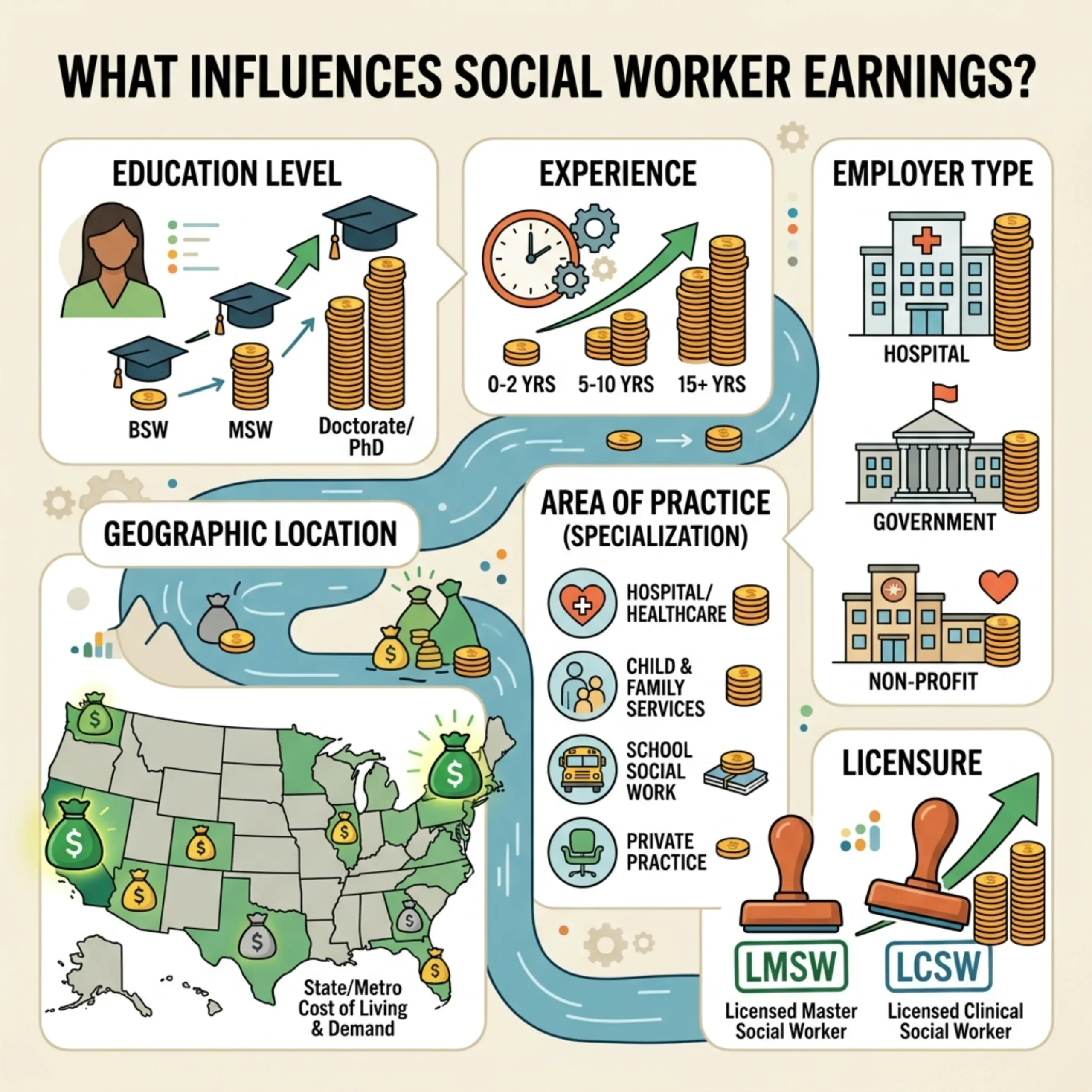
Multiple variables determine the exact figure a professional will see on their paycheck. Social worker earnings are rarely static; they evolve as individuals acquire new skills, move to different areas, or transition between employment sectors.
How do education and credentials affect social worker earnings?
Educational attainment is one of the most reliable predictors of social worker earnings. Professionals entering the field with a Bachelor of Social Work (BSW) typically secure entry-level generalist positions. These roles, while critical, offer the lowest starting social worker earnings.
Conversely, obtaining a Master of Social Work (MSW) unlocks advanced clinical and administrative roles. According to the [National Association of Social Workers, 2023], social workers holding an MSW report significantly higher baseline social worker earnings than their BSW counterparts. Furthermore, state licensure—such as becoming a Licensed Clinical Social Worker (LCSW)—allows professionals to diagnose mental health conditions and bill insurance companies, directly elevating their overall social worker earnings.
What is the impact of experience level on social worker earnings?
Like most professions, social worker earnings increase with tenure. Entry-level salaries generally reflect the learning curve associated with new graduates. As professionals gain practical experience managing complex cases, their market value rises. Mid-career professionals often see a steady bump in their social worker earnings as they assume supervisory responsibilities. Experienced professionals with decades in the field, particularly those in leadership or specialized clinical roles, command the highest social worker earnings within their respective organizations.
How do specialization areas impact social worker earnings?
The specific focus of a professional’s daily work heavily dictates their compensation.
- Clinical social work: These roles often require an MSW and an LCSW credential. Because clinical professionals provide therapy and mental health interventions, their social worker earnings are typically among the highest.
- Child and family social work: Often employed by state agencies, these professionals manage heavy caseloads. While rewarding, child and family social worker earnings are often moderate compared to clinical roles.
- Healthcare social work: Medical social workers assisting patients with hospital discharges and chronic illness management generally report strong social worker earnings due to the robust funding of healthcare systems.
- School social work: Employed by educational districts, school social worker earnings frequently align with teacher salary schedules, sometimes including union protections and pension benefits.
- Macro social work (policy, administration): Professionals focusing on systemic change, grant writing, or agency direction can achieve excellent social worker earnings, particularly in executive non-profit or government roles.
How does geographic location alter social worker earnings?
Geography plays a massive role in shaping social worker earnings. The highest-paying states for social workers—frequently cited as California, Hawaii, New York, and Massachusetts [Bureau of Labor Statistics, 2023]—offer robust salaries to offset expensive housing and transportation. Rural versus urban discrepancies also exist. Urban centers generally provide higher social worker earnings due to greater demand and concentrated healthcare infrastructure. However, professionals must always weigh their gross social worker earnings against the local cost of living to determine true financial health.
What type of employer pays the highest social worker earnings?
An individual’s chosen sector dramatically shifts their social worker earnings potential. Government agencies (local, state, and federal) often provide competitive base salaries accompanied by exceptional pension plans. Non-profit organizations vary widely; well-funded national non-profits offer strong social worker earnings, while small community grassroots organizations may pay less. Private practice allows LCSWs to set their own hourly rates, often resulting in the highest possible social worker earnings, though it requires covering personal overhead costs. Hospitals and healthcare systems consistently offer above-average social worker earnings due to the specialized nature of medical care.
What are the average social worker earnings by specialization?
To understand the financial landscape, we must look at the data surrounding specific roles. The demand for specific specializations directly correlates to the compensation offered.
Healthcare social worker earnings average approximately $60,840 annually [Bureau of Labor Statistics, 2022]. This high average is driven by the urgent need for patient advocacy within complex medical systems. Mental health and substance abuse social worker earnings sit near $49,130, reflecting the critical, ongoing demand for addiction counseling and therapy. Meanwhile, child, family, and school social worker earnings average around $50,820.
As the population ages, the demand for geriatric and medical social workers continues to surge, effectively driving up social worker earnings in these health-adjacent sectors. Choosing a specialization based on upcoming demographic trends is a smart way to maximize future social worker earnings.

How can professionals manage their social worker earnings and finances?
Effectively managing money is just as important as earning it. Because starting social worker earnings can be modest, mastering personal finance is crucial for long-term stability.
Budgeting tips for social workers often focus on aggressive debt management. Student loan management is a massive component of navigating social worker earnings. Many professionals carry significant graduate school debt. Utilizing programs like the Public Service Loan Forgiveness (PSLF) program can erase debt after 120 qualifying payments, vastly improving a social worker’s net worth over time.
Many professionals look for ways to supplement their primary social worker earnings. It is common to see individuals searching for remote side gigs. For example, exploring How to Earn Money Online Facebook groups can yield legitimate freelance writing, telehealth, or consulting opportunities. However, ethical boundaries must be maintained. Furthermore, professionals must be vigilant against scams. Debunking myths about How to Become Rich Fast is essential; sustainable wealth generation relies on steady career advancement, maximizing employer match retirement accounts, and disciplined budgeting, rather than risky overnight schemes.
What is the future outlook for social worker earnings and demand?

The macroeconomic outlook for this profession is remarkably strong. Projected job growth for social workers is expected to increase by 7% between 2022 and 2032, which is faster than the average for all occupations [Bureau of Labor Statistics, 2022]. This sustained demand will inherently place upward pressure on social worker earnings across the board.
Emerging areas in social work, such as corporate social responsibility, veteran assistance, and telehealth therapy, are opening new revenue streams. Additionally, ongoing advocacy and policy changes aimed at recognizing social workers as essential healthcare providers are likely to improve Medicare reimbursement rates. As these systemic changes take root, the ceiling for social worker earnings will continue to rise.
Conclusion
The landscape of social worker earnings is complex but highly navigable. While the profession is rooted in service and advocacy, professionals do not have to sacrifice financial stability to make a difference in the world. By understanding the factors that dictate pay—such as securing an MSW, obtaining clinical licensure, choosing high-demand sectors like healthcare, and understanding geographic variations—you can strategically guide your career.
Ultimately, maximizing your social worker earnings requires a blend of professional development, strategic career transitions, and smart financial management. Take the next step today by auditing your current credentials, exploring local licensing requirements, and evaluating whether a specialization shift aligns with your long-term financial and personal goals.
Frequently Asked Questions (FAQs)
Q1: What is the average social worker salary in the US?
According to the Bureau of Labor Statistics, the median annual wage for social workers is approximately $50,390. Actual salaries vary based on education, experience, and industry sector.
Q2: Do social workers with a Master’s degree earn more?
Yes. A Master of Social Work (MSW) increases earning potential and is required for clinical licensure and many leadership positions.
Q3: Which social work specialization pays the most?
Clinical healthcare social work and private practice therapy generally offer the highest salaries because professionals can diagnose conditions and bill insurance providers.
Q4: How does location affect social worker salaries?
Urban areas and states with strong healthcare systems usually offer higher salaries than rural regions due to greater demand and higher living costs.
Q5: Can social workers have a private practice?
Yes. Licensed clinical social workers with an MSW and advanced state licensure, such as an LCSW, can operate private practices.
Q6: What are the highest paying states for social workers?
Top-paying states often include California, Hawaii, Massachusetts, Rhode Island, and New York.
Q7: Is it hard to become a social worker?
Yes. The profession requires academic study, supervised fieldwork, and licensing exams before entering the workforce.
Q8: What benefits do social workers typically receive?
Many employers provide health insurance, retirement plans, paid leave, and student loan forgiveness opportunities in addition to salary.
Q9: How can I increase my earning potential as a social worker?
Earning an MSW, obtaining clinical licensure, specializing in healthcare, or relocating to higher-paying states can improve salary potential.
Q10: Do government jobs pay better than non-profits?
Government positions often provide more stable salaries and stronger retirement benefits compared to many nonprofit organizations.
Q11: How do student loans affect take-home pay?
Student loan payments can reduce net income significantly. Programs like Public Service Loan Forgiveness (PSLF) help many professionals manage debt.
Q12: Can social workers earn extra income?
Yes. Many professionals earn additional income through telehealth therapy, consulting, teaching, or freelance mental health writing.


Leave a Reply