

Native ads for CPA marketing outperform traditional display formats by blending seamlessly into content feeds, reducing ad fatigue, and driving higher-quality conversions. When paired with platforms like Facebook Ads and Google Ads, micro-influencer partnerships, and optimized CPA landing pages, native advertising becomes one of the most cost-efficient strategies available to performance marketers.
Digital advertising has gone through a quiet revolution. Banner blindness is real—studies show users ignore display ads at a staggering rate, with some research suggesting click-through rates for display ads have dropped to as low as 0.1%. Meanwhile, native ads for CPA marketing are quietly outpacing traditional formats across nearly every performance metric that matters.
CPA (cost-per-action) marketers live and die by conversions. Every dollar spent needs to produce a measurable action—a sign-up, a purchase, a lead. That pressure demands advertising formats that don’t just attract eyeballs, but move people to act. Native ads meet that challenge head-on.
Unlike disruptive pop-ups or banner ads that interrupt the browsing experience, native advertising integrates naturally into the content environment. A reader scrolling through a news site or social feed encounters native ads that look and feel like editorial content. That familiarity lowers psychological resistance and increases the likelihood of engagement.
This guide covers everything you need to know about native ads for CPA marketing—from foundational concepts to advanced platform strategies on Facebook Ads and Google Ads, micro-influencer collaborations, and CPA landing page optimization.
What Are Native Ads for CPA Marketing?
Defining Native Advertising in a Performance Context
Native advertising refers to paid content that matches the form and function of the platform on which it appears. The ad doesn’t look like an ad—it looks like content. That distinction is the foundation of its effectiveness.
In the context of CPA marketing, native ads serve as the top and mid-funnel entry points that guide users toward a specific, trackable action. Rather than pushing a hard sell, native ads build context and intent before the conversion moment.
How Native Ads Differ from Display Advertising
Display ads are visually distinct from the surrounding content. They occupy dedicated ad slots—sidebars, header banners, interstitials—and users have been conditioned to tune them out. Native ads, by contrast, appear within the content stream itself.
This placement difference has a measurable impact. According to Outbrain, native ads generate 53% more views than display ads and produce an 18% higher lift in purchase intent.
Types of Native Ads Used in CPA Campaigns
- In-feed ads: Appear within social media or news feeds, mimicking organic posts
- Sponsored content: Long-form articles or videos produced by or for a brand, published on third-party platforms
- Content recommendation widgets: “You might also like” modules at the bottom of articles (common on platforms like Taboola and Outbrain)
- Branded articles: Native editorial content hosted on publisher sites
- Search-integrated ads: Google Discovery and Performance Max ads that blend with organic results
Each format plays a different role in the CPA marketing funnel. In-feed ads excel at awareness and click generation, while sponsored content and branded articles build the trust needed to push users toward conversion.
Why Native Ads Work for CPA Marketing
The Psychology Behind Non-Disruptive Advertising
Users don’t resist all advertising—they resist advertising that interrupts them. Native ads for CPA marketing succeed because they respect the user’s browsing intent. When an ad matches the tone and format of surrounding content, it triggers less cognitive resistance.
This psychological alignment translates directly into performance. A study by IPG Media Lab found that consumers looked at native ads 53% more frequently than display ads, and native ads registered an 18% higher lift in purchase intent.
Higher Engagement Rates and Conversion Quality
Click-through rates are only part of the story. What matters in CPA marketing is what happens after the click. Native ad traffic tends to arrive with higher intent and more contextual relevance, which means lower bounce rates and higher conversion rates on the CPA landing page.
Cost-Effectiveness for Qualified Lead Generation
Native ads for CPA marketing typically deliver a lower cost per acquisition over time. Because the traffic quality is higher and the pre-click messaging is more aligned with user interests, the downstream conversion funnel operates more efficiently. Advertisers spend less convincing users who were already partially persuaded by the content context.
Native Ads for CPA Marketing with Facebook Ads
Leveraging Facebook’s Native Ad Placements
Facebook’s advertising ecosystem is built around native-style formats. Feed ads, Reels ads, and Stories placements all blend into the organic content experience. For CPA marketing with Facebook Ads, this means advertisers can reach highly segmented audiences without triggering the visual resistance associated with traditional display formats.
Facebook’s Meta Ads Manager gives CPA marketers granular control over placement, format, and bidding strategy. Choosing “Conversion” as the campaign objective optimizes delivery toward users most likely to complete the target action.
Setting Up Native-Style Campaigns on Facebook
Effective CPA marketing with Facebook Ads requires creative assets that look organic. Use real imagery over stock photos, write copy in a conversational tone, and ensure the visual format matches the platform’s content style. Video content, in particular, performs strongly in Facebook’s native feed placements.
For CPA campaigns, dynamic creative testing allows marketers to run multiple headline, image, and copy combinations simultaneously, with the algorithm allocating budget toward the best-performing variants automatically.
Best Practices for Facebook Native Ad Performance
- Use social proof elements (testimonials, user counts, ratings) in ad copy to boost credibility
- Target lookalike audiences built from existing converters for higher-quality traffic
- Set frequency caps to prevent ad fatigue, which degrades both engagement and conversion rates
- Align landing page messaging precisely with the ad creative to reduce post-click drop-off
Native Ads for CPA Marketing with Google Ads
Google’s Native Ad Formats for Performance Campaigns
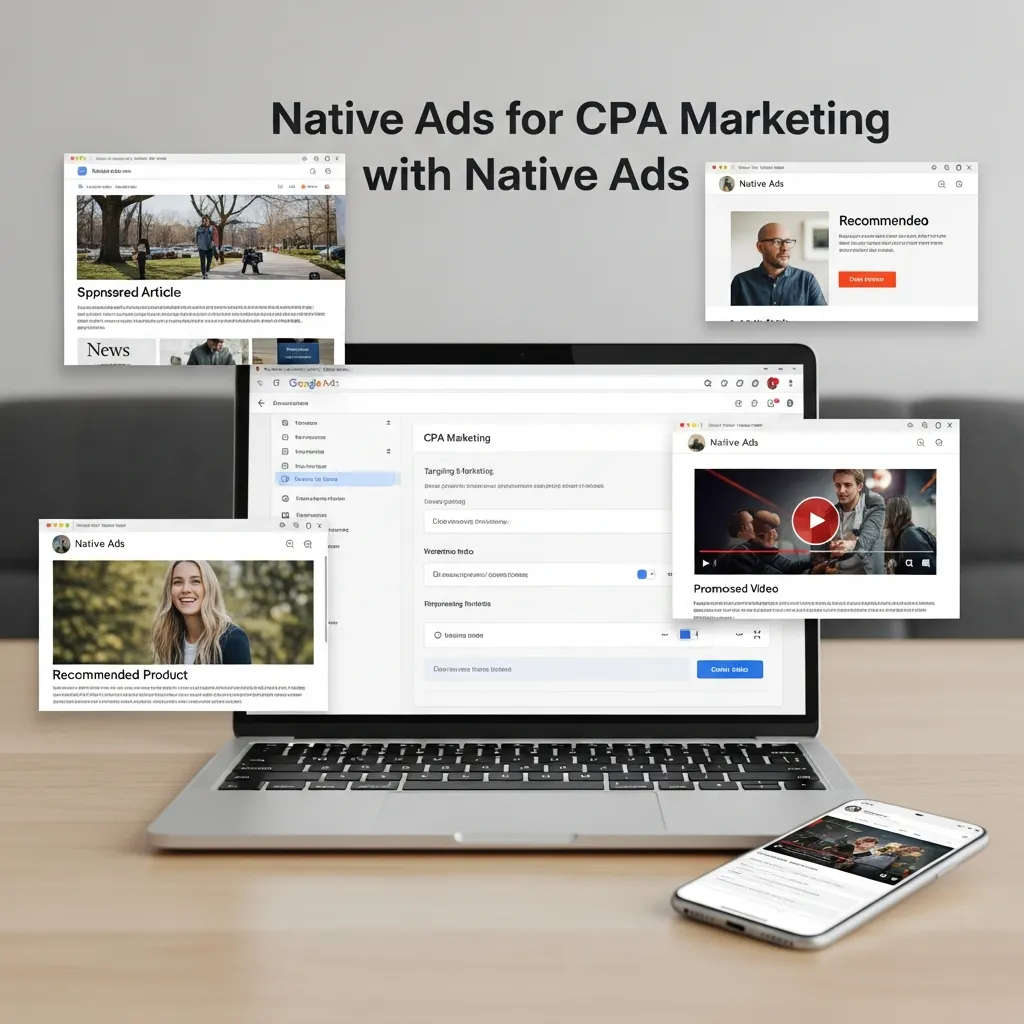
CPA marketing with Google Ads leverages several native-style placements. Discovery campaigns—now evolving into Demand Gen campaigns—place ads across Gmail, YouTube’s home feed, and the Google Discover feed. These placements function as native ads because they appear within content streams users are actively browsing.
Performance Max campaigns take this further by distributing creatives across all Google inventory, with machine learning optimizing toward the defined CPA goal.
Targeting High-Intent Audiences with Google Native Ads
Google’s audience targeting for native ad placements includes in-market audiences (users actively researching relevant products), custom intent audiences (built around specific search queries), and affinity segments. For CPA marketing, in-market audiences typically deliver the strongest conversion efficiency because the targeting aligns user intent with offer relevance.
Optimization Techniques for Google Native Performance
- Provide Google’s algorithm with a minimum of 50 conversions per month to unlock Smart Bidding’s full optimization potential
- Upload multiple headline and image variants—Google’s system will test and favor the best performers
- Use conversion value rules to prioritize high-value actions when running CPA campaigns with multiple conversion types
- Monitor search term reports (where available) to identify and exclude irrelevant traffic
CPA Marketing Fundamentals
Understanding the Cost-Per-Action Model
CPA marketing is a performance-based advertising model where the advertiser pays only when a user completes a specific action—a purchase, form submission, app install, or subscription. This structure makes native ads for CPA marketing particularly attractive: the risk profile is lower, and every campaign dollar is accountable to a measurable outcome.
Key Metrics That Define CPA Campaign Success
- Conversion rate: The percentage of ad clicks that result in the target action
- Cost per acquisition (CPA): Total ad spend divided by total conversions
- Return on ad spend (ROAS): Revenue generated per dollar of ad spend
- Click-through rate (CTR): Indicator of creative relevance and audience alignment
- Lifetime value (LTV): Particularly important when evaluating the long-term profitability of acquired customers
Building Effective CPA Campaigns from the Ground Up
A well-structured CPA campaign begins with offer selection—choosing products or services with a clear value proposition and a conversion funnel that can support native ad traffic. The next step is audience definition, followed by creative development, landing page alignment, and ongoing performance optimization based on data signals.
Micro-Influencers for CPA Marketing Success
Why Micro-Influencers Amplify Native Ad Effectiveness
Micro-influencers—typically defined as creators with between 1,000 and 100,000 followers—generate higher engagement rates than macro-influencers or celebrity endorsers. According to Influencer Marketing Hub, micro-influencers achieve engagement rates of around 3.86%, compared to 1.21% for macro-influencers.
For native ads for CPA marketing, this matters because native advertising depends on perceived authenticity. When a micro-influencer creates sponsored content within their regular feed, the post functions as a native ad in its most organic form.read more details : Micro-Influencers for CPA Marketing Success
Identifying and Partnering with Relevant Micro-Influencers
The most effective micro-influencer partnerships for CPA marketing share a strong thematic alignment between the influencer’s content niche and the promoted offer. Tools like AspireIQ, Grin, and Creator.co allow marketers to search influencers by niche, engagement rate, and audience demographics.
Prioritize engagement rate and audience quality over raw follower count. An influencer with 15,000 highly engaged followers in a relevant niche will typically outperform one with 80,000 passive followers.
Measuring Influencer-Driven CPA Conversions
Use unique tracking links and promo codes for each influencer partnership to attribute conversions accurately. UTM parameters and pixel-based tracking provide granular data on the journey from influencer content to completed CPA action.
CPA Landing Page Optimization
Designing Landing Pages That Complement Native Ad Campaigns
The CPA landing page is where the conversion happens—and it must be designed to receive native ad traffic specifically. Users arriving from native ads are in a content-consumption mindset, not a buying mindset. The landing page needs to bridge that gap through a clear, low-friction path to conversion.
A strong CPA landing page maintains message continuity with the ad creative, uses a single focused call-to-action, and minimizes distractions (remove navigation menus, reduce outbound links, and limit visual clutter).
Conversion-Focused Copywriting and Page Structure
- Lead with the primary benefit, not the product features
- Use social proof (testimonials, trust badges, review counts) above the fold
- Structure the page to answer the user’s key objection before they ask it
- Keep forms short—every additional field reduces completion rates
A/B Testing for CPA Landing Page Improvement
Continuous A/B testing is the engine of CPA landing page optimization. Test one element at a time—headline, CTA button color, hero image, form length—to isolate the impact of each change. Tools like Google Optimize, VWO, and Unbounce enable structured testing without requiring developer resources for every experiment.
Mobile Optimization for Native Ad Traffic
A significant portion of native ad traffic arrives on mobile devices. CPA landing pages must load in under three seconds on mobile (Google’s research shows that 53% of mobile visits are abandoned if a page takes longer than three seconds to load), use tap-friendly CTA buttons, and present content in a single-column layout optimized for vertical scrolling.
Native Ads Are the Future of Performance Marketing

Native ads for CPA marketing represent a structural shift in how performance campaigns are built and executed. The days of interruption-based advertising producing reliable CPA results are diminishing. Users have developed sophisticated filters against anything that looks like a traditional ad.
The marketers winning in this environment are those who lead with value, match the content context of their placement, and build conversion funnels that respect user intent at every stage. CPA marketing with Facebook Ads and CPA marketing with Google Ads both offer native-style placements that, when used correctly, deliver lower cost per acquisition and higher-quality traffic than traditional display formats.
Pair those platforms with micro-influencer partnerships and a rigorously optimized CPA landing page, and the result is a performance ecosystem where every component reinforces the others.
The next step is straightforward: choose one platform, build a native-style creative set, and launch a test campaign with a defined CPA goal. Measure, optimize, and scale what works. The data will guide every decision from there.


Leave a Reply