

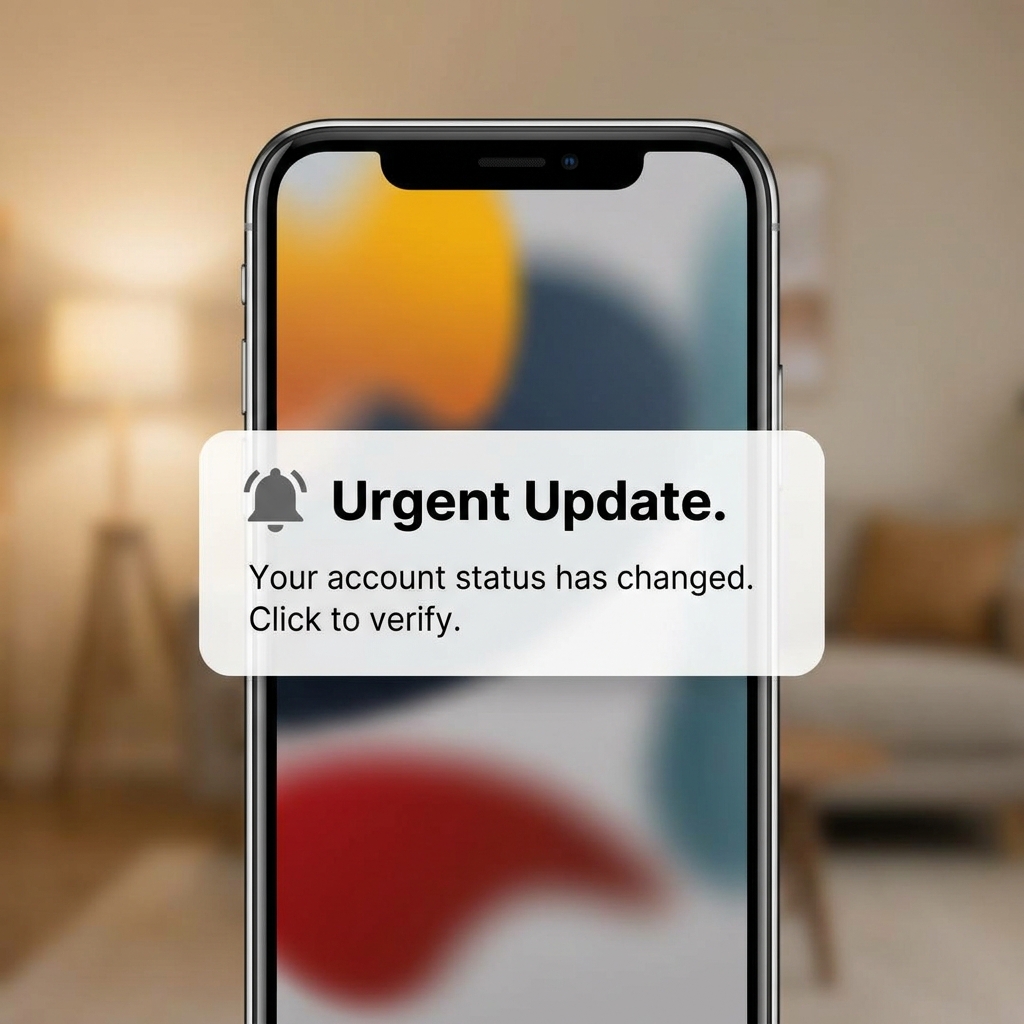
Push traffic has become a popular traffic source for CPA marketers, delivering high-volume, low-cost clicks through browser and in-app push notifications. This guide explores how Push Traffic for CPA Offers works, why it pairs well with CPA campaigns, how to set up and optimize your first campaign, and the common mistakes that can quietly drain your budget before producing conversions. By understanding targeting, creative testing, audience quality, and campaign optimization, you can use Push Traffic for CPA Offers more effectively and build a more efficient paid traffic strategy.
What Is Push Traffic?
Push traffic refers to visitors who arrive at a landing page or offer through push notifications — the short, clickable alerts that appear on a device’s lock screen, notification tray, or browser corner, even when the user isn’t actively browsing a website or app. Unlike search or social traffic, which requires a user to be actively looking for something, push traffic reaches people passively, showing up on their screen whenever the notification fires.
For CPA marketers, push traffic has become popular because it combines low cost-per-click with genuinely large audience pools, since users opt into push notifications across thousands of websites and apps, building subscriber lists that ad networks can then monetize at scale.
How Push Traffic Works
Push notification advertising relies on a subscription model. When a user visits a website that has push notification opt-ins enabled, a browser prompt asks whether they want to allow notifications from that site. Once a user opts in, they become part of a subscriber list that can receive notifications indefinitely, even after they’ve left the original site entirely.
Ad networks that specialize in push traffic aggregate these subscriber lists across thousands of publisher sites, then sell access to advertisers who want to send notifications to that audience. When an advertiser launches a campaign, their notification — typically a short headline, a small image, and a link — gets pushed out to a segment of subscribers matching the advertiser’s targeting criteria, and interested users click through to the CPA offer.
Why Push Traffic Works Well for CPA Offers
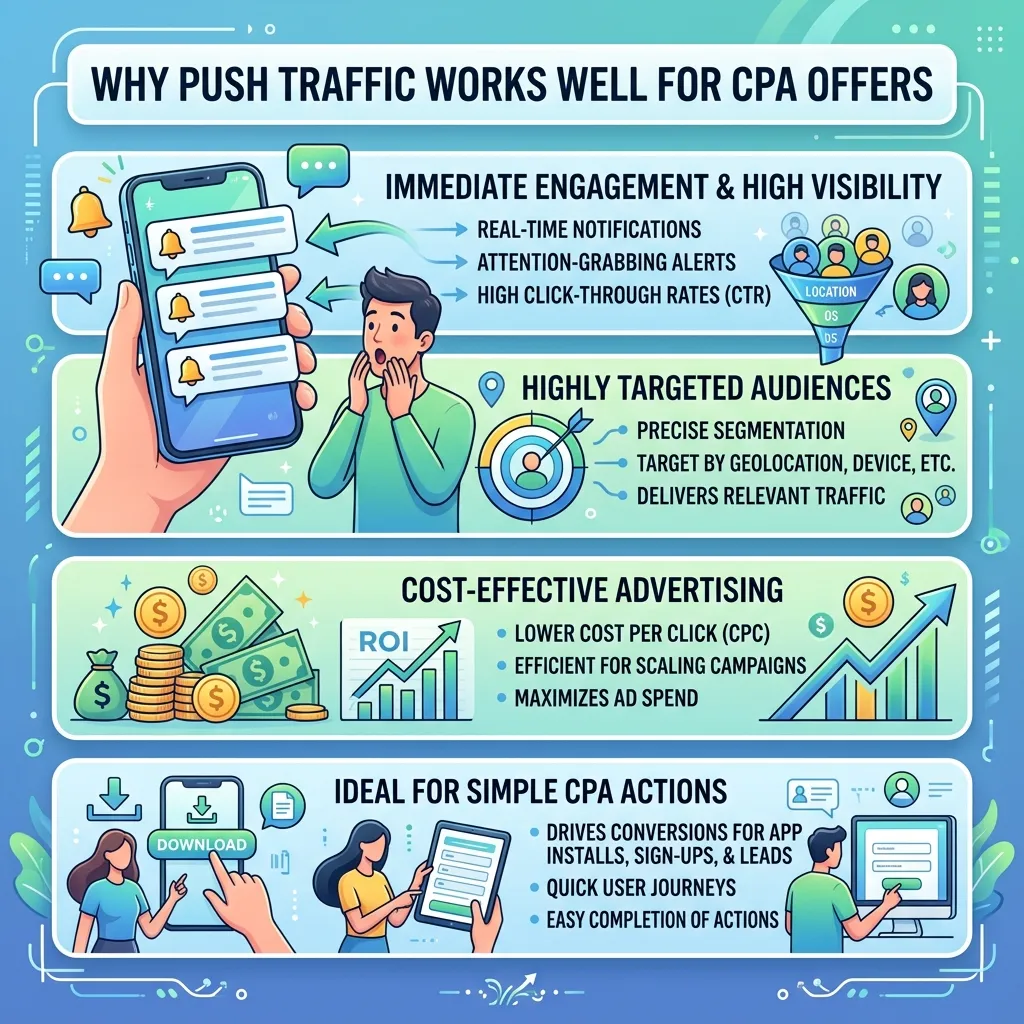
CPA offers — where advertisers pay for a specific action like a sign-up, download, or form submission rather than a sale — tend to perform especially well with push traffic for a few structural reasons.
Low cost per click. Push traffic is generally cheaper than search or social advertising, which matters a lot for CPA campaigns where the payout per action is often modest and margins depend on keeping acquisition costs low.
High volume. Because subscriber lists can run into the millions, push traffic gives CPA marketers access to large-scale audiences quickly, which is useful for testing offers and scaling winners fast.
Impulse-friendly format. The short, curiosity-driven format of push notifications suits impulse-oriented CPA verticals particularly well — sweepstakes, gaming, dating, and utility app installs all tend to convert strongly from push traffic.
Less competition than mainstream channels. Compared to the intense competition on platforms like Google and Facebook, push traffic remains comparatively underused, which can mean lower bids and better margins for marketers willing to learn the format.
Setting Up Your First Push Traffic Campaign
Getting started with push traffic for CPA offers generally follows a consistent process across most ad networks.
1. Choose a push traffic network. Several established networks specialize in push notification advertising, each with different subscriber pools, targeting options, and minimum budgets. It’s worth testing more than one network, since subscriber quality can vary significantly between them.
2. Select your CPA offer. Match your offer to the audience push traffic tends to attract — impulse-driven, curiosity-based offers with a low barrier to conversion typically outperform offers requiring a long, detailed sign-up process.
3. Write your notification creative. Push notification ad copy is short by necessity, usually limited to a headline and brief description, so every word needs to earn its place. Curiosity gaps, urgency, and clear benefit statements tend to perform best.
4. Set your targeting. Most push traffic networks allow targeting by device type, operating system, geography, carrier, and sometimes subscriber recency, letting you narrow in on the audience most likely to convert on your specific CPA offer.
5. Launch with a testing budget. Start with a modest daily budget spread across several creative and targeting variations before committing significant spend to any single combination.
Optimizing Push Traffic Campaigns for Better ROI
Once a campaign is live, ongoing optimization is what separates profitable push traffic campaigns from ones that quietly bleed budget.
Monitor click-through rate and conversion rate separately. A high click-through rate with a low conversion rate usually signals a mismatch between your ad creative and your landing page or offer, not a targeting problem.
Cut underperforming placements quickly. Push traffic networks typically report performance by publisher zone or subscriber segment, and pausing weak zones early protects budget for the segments actually converting.
Test notification creative frequently. Because push traffic audiences see a high volume of notifications daily, creative fatigue sets in faster than with other channels, making regular creative rotation especially important.
Match landing pages to notification promises. If your notification implies urgency or a specific offer, your landing page needs to deliver on that promise immediately, or bounce rates on push traffic tend to spike.
Watch frequency capping. Sending too many notifications to the same subscriber segment in a short window can trigger opt-outs and lower engagement across future campaigns.
For marketers still comparing traffic sources before committing budget specifically to push, this roundup of best CPA traffic sources for beginners is a useful starting point for understanding how push stacks up against social, search, and native options.
Common Mistakes to Avoid With Push Traffic
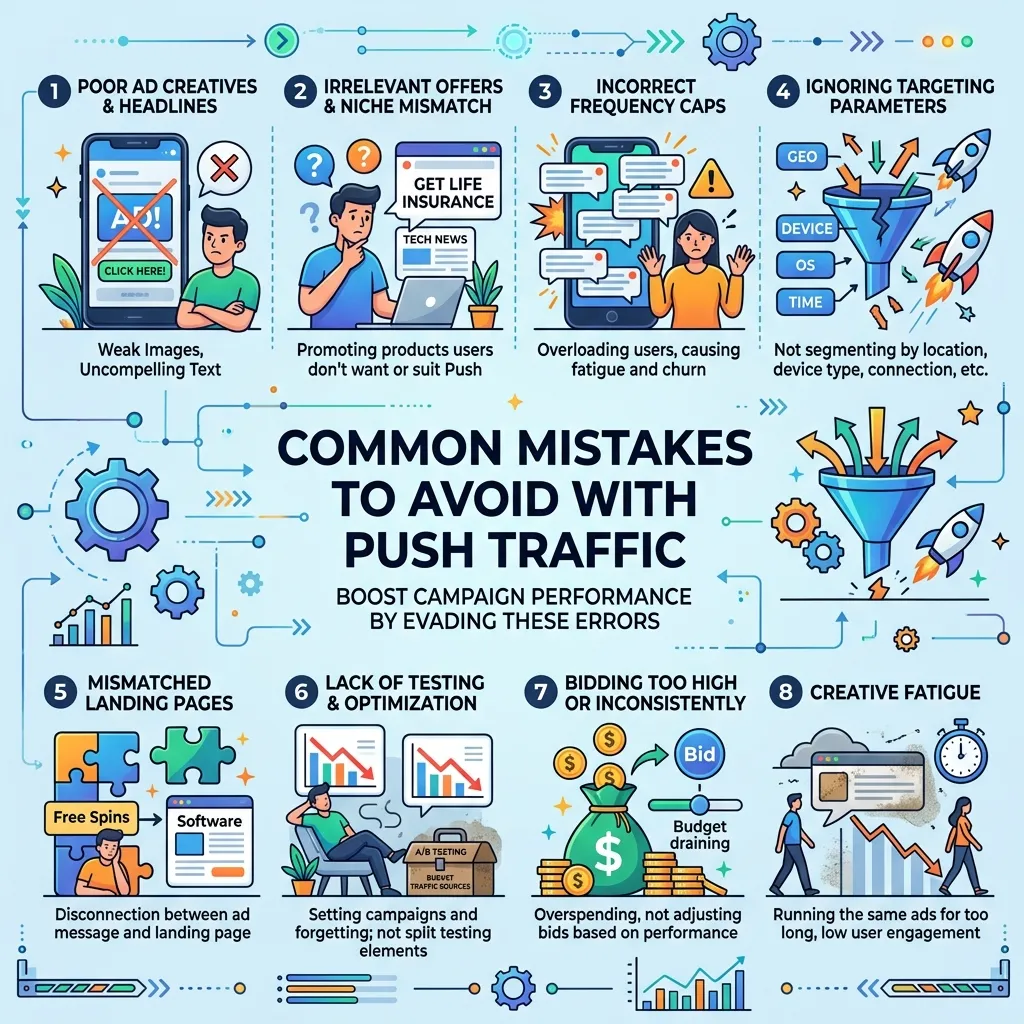
Ignoring device and OS segmentation. Push traffic performs very differently across desktop, Android, and iOS, and lumping all traffic together in one campaign often hides which segment is actually profitable.
Using vague or misleading creative. While curiosity-driven copy performs well, creative that overpromises relative to the actual offer leads to high bounce rates and can damage account standing with ad networks over time.
Skipping landing page testing. Many marketers pour effort into notification creative but neglect landing page optimization, even though the landing page is where most of the conversion actually happens. This CPA landing page optimization guide covers the structural elements worth testing once traffic starts flowing.
Scaling too fast on unproven data. Push traffic campaigns can generate volume quickly, which sometimes tempts marketers to scale budget before a campaign has enough data to confirm it’s actually profitable.
Neglecting frequency and subscriber freshness. Older subscriber segments tend to convert at lower rates than recently opted-in users, and campaigns that don’t account for this often see performance decline over time without an obvious cause.
Budgeting for Push Traffic Campaigns
One of the trickiest parts of running push traffic for CPA offers is deciding how much to spend before you have enough data to know whether a campaign is actually working. A common approach is to set a testing budget equal to roughly 20 to 30 times your target payout per conversion, spread across a handful of creative and targeting variations. This gives the campaign enough volume to surface a meaningful click-through and conversion pattern without risking a large portion of your budget on a single unproven combination.
Once a campaign shows a consistent, profitable pattern over a few days of spend, it’s generally safer to scale gradually — increasing daily budget by a modest percentage rather than multiplying it overnight. Push traffic networks can absorb large budget increases quickly given their subscriber volume, but sudden scaling often pulls in lower-quality traffic segments that weren’t part of the original profitable pattern, which can quietly erode margins even while overall volume looks healthy on the surface.
It’s also worth tracking cost per click alongside cost per conversion separately by campaign, since a cheap click that never converts is often more expensive in the long run than a slightly pricier click from a better-targeted segment. Many marketers underestimate how much campaign profitability depends on this kind of granular tracking rather than headline traffic volume alone.
A Simple Framework for Testing New Push Traffic Offers
When testing a new CPA offer with push traffic, it helps to follow a consistent framework rather than testing everything at once:
- Start with one network and one geography. Narrowing your first test to a single traffic source and location makes it far easier to isolate what’s actually driving performance.
- Test two or three creative variations, not ten. Spreading a small testing budget across too many variations makes it hard for any single one to gather enough data to draw a real conclusion.
- Give each test enough volume before judging it. A handful of clicks isn’t enough to declare an offer dead — most networks recommend waiting until a campaign has generated at least a few hundred clicks before making optimization decisions.
- Isolate one variable at a time when iterating. Changing creative, targeting, and landing page simultaneously makes it impossible to know which change actually moved performance.
- Document what works and what doesn’t. Over time, a simple log of tested creative angles, verticals, and targeting combinations becomes one of the most valuable assets a push traffic campaign manager can build, since patterns often repeat across similar offers.
Compared to search traffic, push traffic tends to be cheaper but less intent-driven, since users aren’t actively searching for a solution when a notification appears. Compared to native advertising, push traffic is generally faster to set up and test, though native often blends more naturally into a publisher’s content and can produce higher-quality clicks for certain verticals. Compared to social advertising, push traffic typically faces fewer creative restrictions, making it a common choice for CPA verticals that struggle to get approved on platforms like Facebook.
Most experienced CPA marketers don’t rely on a single traffic source exclusively — push traffic tends to work best as part of a broader mix, tested alongside native, social, and search depending on the specific offer and vertical. For marketers building out a broader scaling strategy across multiple channels, this guide on CPA marketing traffic scaling covers how to expand a campaign once push traffic (or any single source) proves profitable.
Push Traffic Verticals That Perform Best
Not every CPA vertical performs equally well with push traffic. Verticals that consistently see strong results include:
- Sweepstakes and giveaways: The impulse, curiosity-driven nature of push notifications suits low-friction sweepstakes offers particularly well.
- Mobile gaming and app installs: Push traffic’s mobile-heavy subscriber base makes it a natural fit for app install campaigns.
- Dating offers: The curiosity and urgency angles common in push creative align well with dating vertical messaging.
- Utility and VPN apps: Simple, low-commitment installs convert reliably from push traffic’s impulse-driven audience.
- Antivirus and security software: Urgency-based messaging around device security performs consistently well through push notification formats.
The Technical Side of Push Notifications
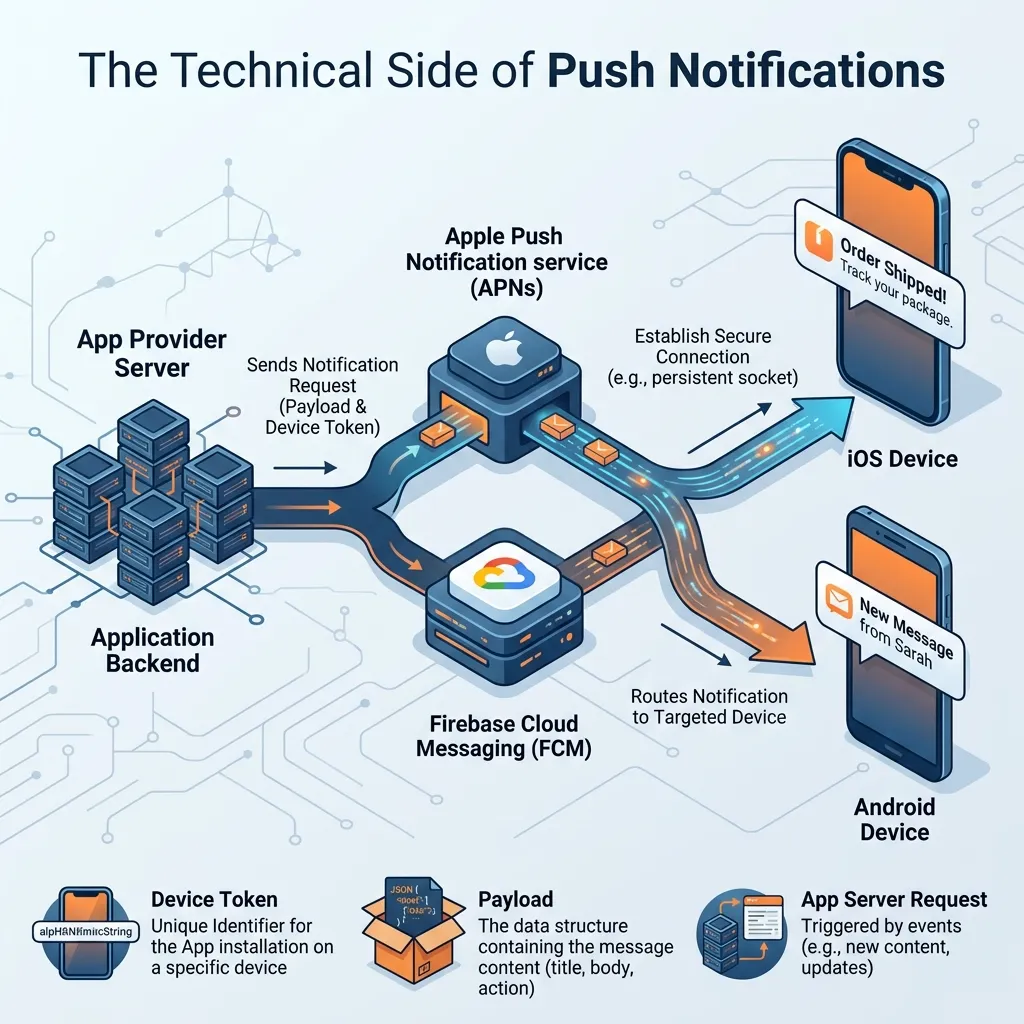
Understanding the underlying technology helps explain why push traffic behaves the way it does. Browser push notifications rely on a web standard that lets sites request permission to send messages even when a user isn’t actively on the page, which is what makes long-term subscriber engagement possible in the first place. For a deeper technical reference on how the underlying protocol works, the W3C Push API specification documents the standard that browser-based push notification systems are built on.
Conclusion
Push traffic remains one of the more accessible, cost-effective traffic sources available to CPA marketers, particularly for impulse-driven verticals like sweepstakes, gaming, and dating offers. Success with push traffic depends less on the channel itself and more on disciplined testing — matching creative to offer, segmenting by device and OS, optimizing landing pages, and scaling only once the data supports it. Treated as one part of a broader traffic mix rather than a standalone strategy, push traffic can be a durable, profitable channel for CPA campaigns.
Frequently Asked Questions
1. What is push traffic in CPA marketing?
Push Traffic for CPA Offers refers to visitors who click through from push notifications sent to subscribers who previously opted in on a publisher website or app. It allows advertisers to reach users directly through notification-based campaigns.
2. Is push traffic good for beginners in CPA marketing?
Yes. Push Traffic for CPA Offers can be a useful starting point because it is relatively affordable and straightforward to set up. Beginners can test different offers, creatives, and targeting options without requiring a large initial budget.
3. How much does push traffic typically cost?
Costs vary depending on the advertising network, target country, device, and competition. Push Traffic for CPA Offers is commonly priced using cost-per-click (CPC) or cost-per-mille (CPM) models and can be relatively inexpensive compared with some other paid traffic sources.
4. Which CPA verticals work best with push traffic?
Sweepstakes, mobile gaming, dating, and utility app offers often work well with Push Traffic for CPA Offers because push notifications can encourage quick user engagement. Performance still depends on the offer, audience, creative, and targeting.
5. Why is my push traffic getting clicks but no conversions?
A high number of clicks with few conversions can indicate a mismatch between the notification creative, landing page, audience, or CPA offer. When optimizing Push Traffic for CPA Offers, review the complete user journey instead of focusing only on click volume.
6. How do I choose a push traffic network?
Compare subscriber volume, targeting options, traffic quality, minimum budgets, available countries, and reporting features. Choosing the right network is an important part of building an effective Push Traffic for CPA Offers campaign.
7. Can push traffic be used with mainstream CPA networks?
Yes. Many established CPA networks accept push traffic, although individual offers may have specific traffic restrictions. Always review the offer’s terms before launching a Push Traffic for CPA Offers campaign.
8. How often should I refresh push notification creative?
Refreshing creatives every one to two weeks can help reduce audience fatigue, although the ideal schedule depends on traffic volume and campaign performance. Regular creative testing is an important part of optimizing Push Traffic for CPA Offers.
9. Is push traffic better than native advertising for CPA offers?
Neither is universally better. Push traffic can be faster and less expensive to test, while native advertising may deliver higher-quality engagement for certain verticals. The right choice depends on your goals, offer, audience, and budget.
10. What targeting options are available with push traffic?
Most networks offer targeting options such as device type, operating system, geography, carrier, and sometimes subscriber recency or engagement. These options allow marketers to refine their Push Traffic for CPA Offers campaigns and focus spending on relevant audiences.
11. How do I avoid subscriber fatigue with push traffic?
Use frequency capping to control how often users receive notifications and avoid repeatedly showing the same creative. Testing different messages and prioritizing relevant audiences can improve the user experience and campaign performance.
12. Can push traffic work for desktop CPA offers, not just mobile?
Yes. Push traffic can reach both desktop and mobile users, although available inventory, targeting options, and conversion rates can vary between devices. Testing both audiences can help determine where Push Traffic for CPA Offers performs best.


Leave a Reply