

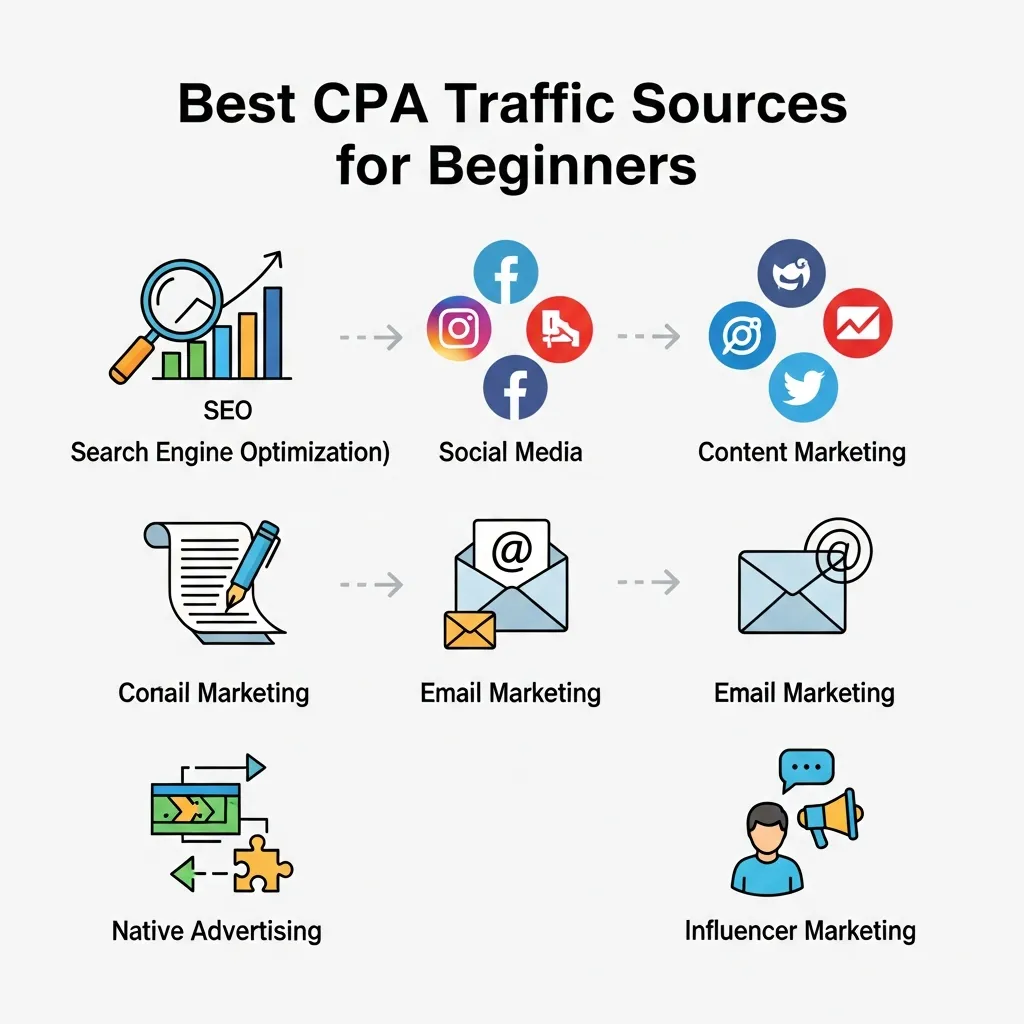
The best CPA traffic sources for beginners include native advertising, social media platforms, search engine marketing, email marketing, SEO content, YouTube, and influencer partnerships. Starting with one or two channels, setting a small test budget, and tracking conversions precisely are the fastest ways to grow a profitable CPA marketing campaign from scratch.
CPA marketing has one of the lowest barriers to entry in the digital advertising space—but “low barrier” doesn’t mean “no strategy.” The difference between a beginner who quits after their first campaign and one who scales to consistent commissions often comes down to a single decision: choosing the right traffic source.
Get traffic wrong, and even the highest-converting CPA offer won’t save you. Get it right, and a modest starting budget can snowball into a reliable revenue stream. That’s the core challenge of beginner CPA marketing, and it’s exactly what this guide addresses.
This post breaks down the best CPA traffic sources for beginners, explains how each one works, and gives you a practical framework for testing, tracking, and scaling. Whether you’re starting with $50 or $500, you’ll find a traffic strategy that fits your budget, niche, and skill level.
What Is CPA Marketing and Why Does Traffic Matter So Much?
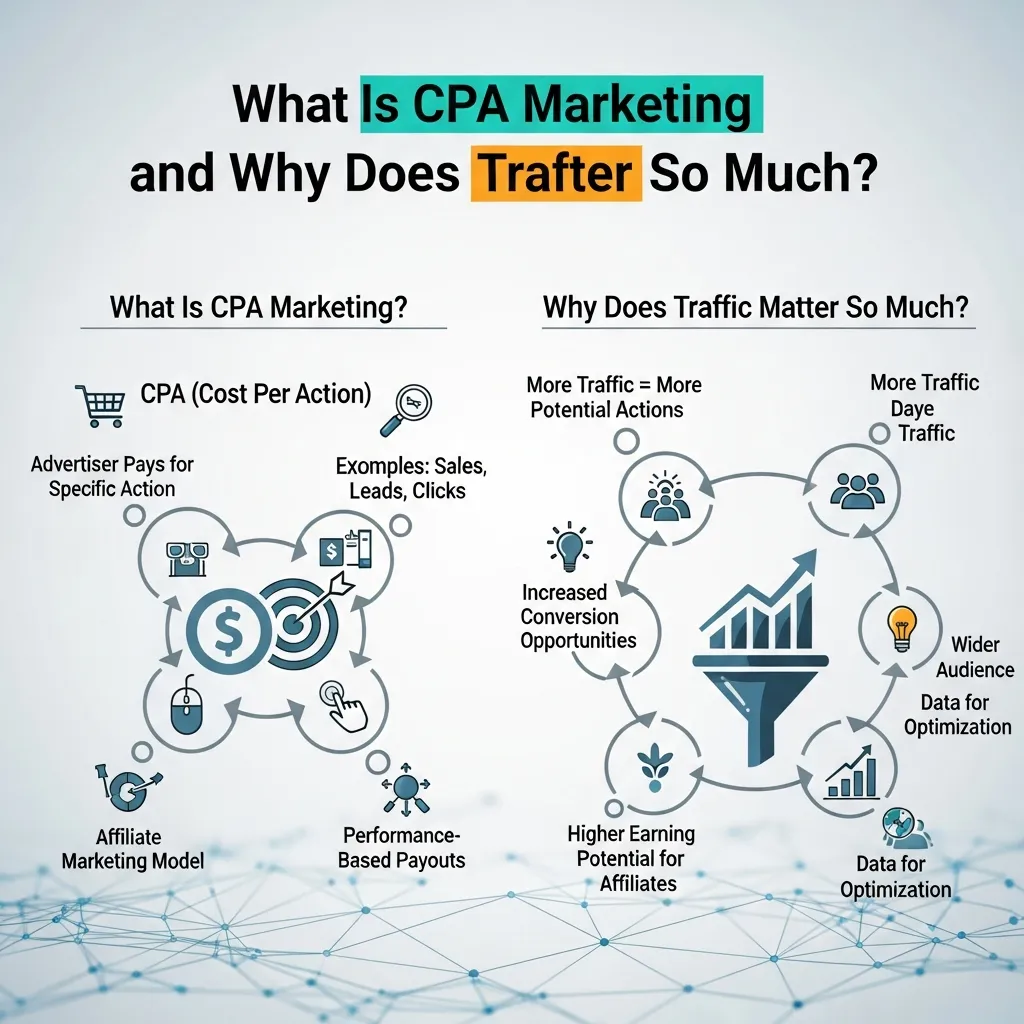
Understanding the Cost Per Action model
CPA marketing—short for Cost Per Action—is a type of affiliate marketing where you earn a commission every time a referred user completes a specific action. That action might be filling out a form, signing up for a trial, downloading an app, or making a purchase.
Unlike pay-per-click (PPC) affiliate models where you earn every time someone clicks your link, or CPM models where impressions drive revenue, CPA marketing ties your income directly to user behavior. No action, no payout.
How CPA differs from other affiliate marketing models
The key distinction is risk distribution. With CPA marketing, the advertiser absorbs most of the financial risk—they only pay when a conversion happens. As a publisher or affiliate, your job is to deliver qualified traffic that converts. This makes CPA marketing particularly attractive for beginners who want predictable, performance-based earnings without managing a product or handling customer service.
Why beginners gravitate toward CPA marketing
CPA networks like MaxBounty, PeerFly, and ClickDealer give beginners access to hundreds of pre-built offers across niches like finance, health, gaming, and e-commerce. The learning curve is steep but manageable, especially when you start with a single traffic source and a well-defined niche audience.
Best CPA Traffic Sources for Beginners
Native advertising platforms (Taboola, Outbrain)
Native advertising blends promotional content into editorial feeds on news sites and content platforms. Taboola and Outbrain are the two dominant platforms in this space, reaching billions of monthly users across premium publishers like CNN, Forbes, and NBC.
For beginner CPA marketing, native ads offer a strong middle ground between cost and intent. Users are already consuming content, which makes them receptive to advertorial-style landing pages. Native traffic tends to convert well for offers in finance, health, and lifestyle niches.
What to expect: CPCs typically range from $0.05 to $0.80 depending on the geo and niche. Compliance requirements are moderate—most native platforms prohibit aggressive before/after claims and misleading headlines.
Social media marketing (Facebook, Instagram, TikTok)
Social media remains one of the most powerful CPA traffic sources for beginners with any budget. Facebook’s advertising platform offers granular audience targeting based on interests, behaviors, demographics, and lookalike audiences. Instagram performs exceptionally well for visual niches like beauty, fashion, and fitness. TikTok has emerged as a high-ROI channel for younger demographics and impulse-driven CPA offers.
The key advantage of social media for beginner CPA marketing is the targeting precision. You can reach a hyper-specific audience with a $20/day budget and collect real data before scaling.
What to watch: Policy compliance is strict. Facebook, in particular, has tight restrictions on certain CPA verticals—especially health claims, financial products, and nutraceuticals. Always review platform policies before launching.
Search engine marketing (Google Ads, Bing Ads)
Search traffic is high-intent traffic. When someone searches “best debt consolidation loans” or “free VPN download,” they’re already looking for a solution. Google Ads and Bing Ads let you intercept that intent at the exact moment of search—making SEM one of the highest-converting CPA traffic sources available.
Bing Ads (now Microsoft Advertising) tends to be overlooked by beginners, but its lower competition translates to cheaper CPCs and a less aggressive learning curve. For beginner CPA marketing, Bing can be a smarter starting point than Google.
Budget reality check: SEM can get expensive fast. Competitive keywords in finance or insurance can exceed $10–$50 per click. Start with long-tail keywords, low daily caps, and closely monitor your conversion data.
Email marketing and list building
Email marketing delivers one of the highest ROIs of any digital channel—according to Litmus, the average ROI is $36 for every $1 spent. For CPA marketing, email allows you to nurture leads over time and promote multiple offers to the same audience without paying for traffic repeatedly.
Building a responsive email list takes time, but the long-term payoff is significant. Lead magnet funnels, landing pages, and opt-in forms are common starting points. Once subscribers are on your list, segmentation and personalization drive conversion rates up substantially.
Compliance note: CAN-SPAM, GDPR, and CASL regulations govern commercial email. Always use a verified ESP (Email Service Provider) like Mailchimp, ActiveCampaign, or ConvertKit, and include a clear unsubscribe mechanism in every message.
Content marketing and SEO
SEO-driven content is the most sustainable CPA traffic source for beginners who can invest time over money. By ranking blog posts, comparison pages, and review content for relevant search queries, you generate organic traffic that converts without ongoing ad spend.
The trade-off is time. Organic rankings typically take three to six months to build, and competitive niches require strong domain authority. However, once established, SEO traffic compounds—a single well-ranked article can generate commissions for years.
Best approach for beginners: Target low-competition, long-tail keywords. Tools like Ahrefs, Semrush, or the free Google Search Console help identify gaps your content can fill.
YouTube and video marketing
YouTube is the world’s second-largest search engine, with over 2.5 billion logged-in monthly users (Google, 2024). Video reviews, tutorials, and comparison content convert exceptionally well for CPA offers because they build trust before the viewer ever clicks your link.
For beginner CPA marketing, YouTube offers a free organic path to traffic—no ad budget required. A review video for a software product or a “how to” tutorial in a profitable niche can rank on both YouTube and Google search results, doubling your visibility.
Pro tip: Always disclose affiliate relationships in your video description and verbally during the content. This is an FTC requirement, not just a best practice.
Influencer partnerships
Micro-influencers (10,000–100,000 followers) offer an increasingly cost-effective CPA traffic source. Rather than paying flat fees, negotiate performance-based deals where the influencer earns a commission per conversion. This aligns incentives and reduces upfront risk for beginner CPA marketers.
Platforms like AspireIQ, Grin, and even direct outreach via Instagram DMs are common starting points. Influencer partnerships work best in lifestyle, fitness, beauty, and consumer tech niches.
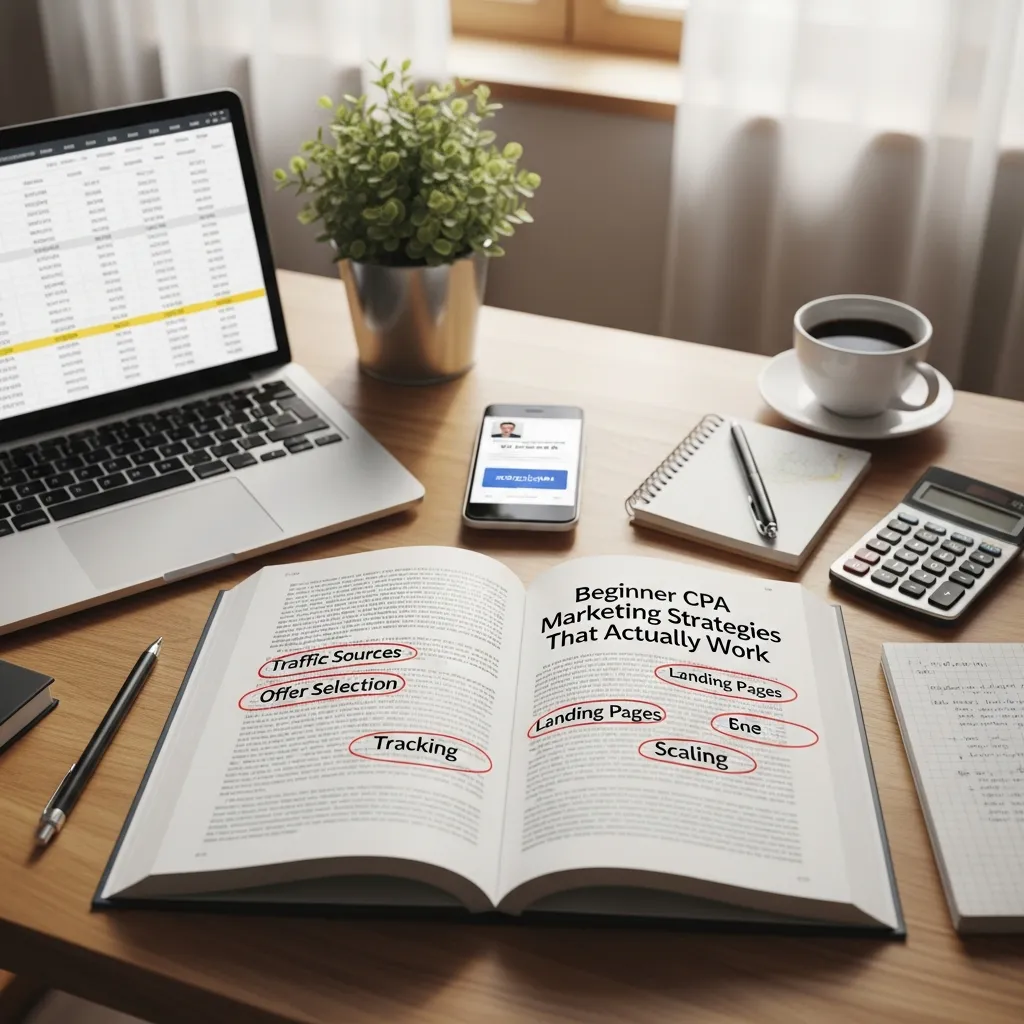
Beginner CPA Marketing Strategies That Actually Work
Starting with low-budget campaigns
Resist the urge to launch at full scale. Start with $20–$50/day, run traffic for at least seven days, and evaluate performance before increasing spend. This “minimum viable campaign” approach protects your budget while generating real data.
Testing and optimizing CPA traffic sources
No traffic source is universally best. A dating offer might convert brilliantly on Facebook but flop on native. A financial CPA offer might thrive on Google Ads but struggle on TikTok. Test one variable at a time—creative, headline, landing page, or audience—and make data-driven decisions.
Understanding audience targeting
The more precisely you define your audience, the less you waste on irrelevant clicks. Build audience personas before launching any campaign. Consider age range, geographic location, device preference, income bracket, and behavioral signals.
Tracking and analytics best practices
You cannot optimize what you cannot measure. Use a dedicated tracking tool—Voluum, RedTrack, or ClickMagick are popular among CPA marketers—to attribute conversions accurately across all traffic sources. Set up postback URLs with your CPA network to capture server-side conversion data.
CPA Traffic Sources Deep Dive: Performance Metrics Compared
|
Traffic Source |
Avg. CPC |
Learning Curve |
Best For |
|---|---|---|---|
|
Native Ads |
$0.05–$0.80 |
Moderate |
Content/lifestyle offers |
|
Facebook Ads |
$0.20–$2.00 |
Moderate-High |
Mass market offers |
|
Google Ads |
$0.50–$10.00+ |
High |
High-intent offers |
|
Email Marketing |
$0.01–$0.10 |
Low-Moderate |
Recurring CPA offers |
|
SEO |
$0 (time cost) |
High (long-term) |
Review/comparison content |
|
YouTube |
$0 organic |
Moderate |
Product reviews |
|
Influencers |
Negotiable |
Low |
Lifestyle/consumer |
Compliance and quality scores: Google Ads uses a Quality Score system that rewards relevant, high-quality landing pages with lower CPCs. Facebook’s relevance score functions similarly. Prioritizing user experience on your landing page isn’t optional—it directly affects your cost per click.
SMS Marketing for CPA Campaigns
Why SMS marketing deserves attention in CPA
SMS marketing boasts open rates of up to 98%, compared to the 20–25% average open rate for email (SimpleTexting, 2023). For time-sensitive CPA offers—flash sales, limited-time trials, event registrations—SMS can drive conversions faster than any other channel.
Building a compliant SMS list
Explicit written consent is mandatory. Under the TCPA (Telephone Consumer Protection Act) in the US, sending unsolicited commercial SMS messages carries significant legal penalties. Use opt-in forms with clear disclosure language, and only message subscribers who have actively consented.
SMS platforms like Postscript, Attentive, and Klaviyo (for e-commerce) include built-in compliance tools and opt-out management.
Best practices for SMS conversions in CPA marketing
- Keep messages under 160 characters
- Include a clear, trackable link (use a URL shortener with UTM parameters)
- Send at appropriate hours (10am–8pm in the recipient’s local timezone)
- Use personalization tokens (first name, location) to boost engagement
- Always include an opt-out option (“Reply STOP to unsubscribe”)
Common Mistakes That Kill Beginner CPA Campaigns
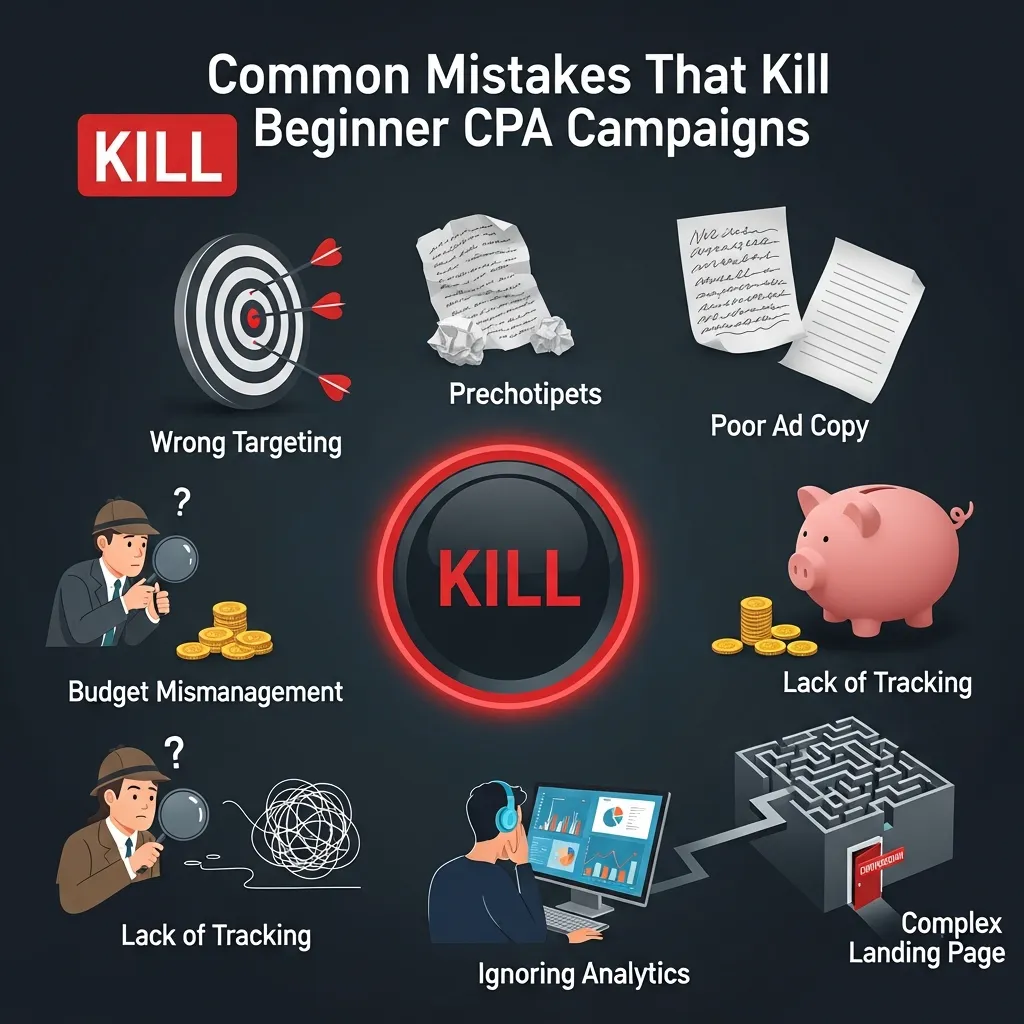
Choosing the wrong traffic source for your offer. A B2B SaaS lead gen offer won’t perform on TikTok. Match your traffic source to your offer’s audience, and research which verticals each platform favors.
Poor audience segmentation. Broad targeting wastes money. Narrow your audience based on real data—age, location, device, interests—and refine as you gather conversion insights.
Ignoring compliance regulations. CPA networks and ad platforms ban accounts for policy violations. Familiarize yourself with FTC guidelines, platform-specific advertising policies, and your CPA network’s terms before running a single ad.
Not tracking conversions properly. Many beginners rely solely on platform-reported data, which is often inaccurate due to iOS tracking changes and ad blockers. Implement server-side tracking or a dedicated CPA tracker to capture the full conversion picture.
Key Takeaways for Beginners
- CPA traffic sources vary significantly in cost, complexity, and conversion potential—choosing the right one for your offer is the most important first decision.
- Beginner CPA marketing works best when you start with one or two traffic sources, test with a small budget, and scale what works.
- Native ads and social media offer the best starting points for most beginners; SEO and email marketing build long-term, cost-efficient traffic.
- SMS marketing delivers exceptional open rates but requires strict compliance with TCPA regulations.
- Tracking is non-negotiable—use a dedicated analytics tool from day one.
- Always match your traffic source to your CPA offer’s audience and niche.
Your Next Steps in CPA Marketing
The roadmap for beginner CPA marketing is clearer than most beginners realize. Pick one traffic source, select a proven CPA offer from a reputable network, set a test budget you can afford to lose, and run traffic for at least two weeks before drawing conclusions.
The affiliates who succeed in CPA marketing aren’t necessarily the ones with the biggest budgets. They’re the ones who track obsessively, optimize consistently, and stay compliant. Start small. Measure everything. Scale what converts.
The right CPA traffic source won’t just drive clicks—it will drive profitable actions. That distinction is what separates beginners from serious CPA marketers.
Frequently Asked Questions About CPA Traffic Sources
What traffic source is best for beginners in CPA marketing?
Native advertising and Facebook Ads are generally the best CPA traffic sources for beginners. Native ads offer lower CPCs and moderate compliance requirements, while Facebook provides granular targeting across a massive audience. Both allow low-budget testing before scaling, which is essential when starting out.
How much budget do I need to start with CPA traffic sources?
A realistic starting budget for beginner CPA marketing is $200–$500 per traffic source. This is enough to gather statistically meaningful data over two to four weeks. Spending less may not produce enough conversions to optimize confidently; spending more before testing is risky.
Which CPA traffic sources have the lowest learning curve?
Email marketing and influencer partnerships have the lowest learning curves for beginner CPA marketers. Email marketing relies on list-building fundamentals and straightforward tracking, while influencer partnerships require negotiation skills but minimal technical setup.
How do I measure ROI across different CPA traffic sources?
Use a dedicated CPA tracking tool like Voluum, ClickMagick, or RedTrack to measure ROI per traffic source. Key metrics to monitor include cost per click (CPC), cost per lead (CPL), conversion rate, and earnings per click (EPC). Compare these against your CPA network’s payout to calculate true ROI.
Is SMS marketing effective for CPA campaigns?
Yes—SMS marketing is highly effective for CPA campaigns when used correctly. With open rates of up to 98% (SimpleTexting, 2023), SMS drives faster engagement than email. It performs particularly well for time-sensitive offers but requires strict TCPA compliance and explicit subscriber consent.
What compliance issues should I consider with each CPA traffic source?
Each traffic source has its own compliance framework. Google Ads and Facebook enforce platform-specific advertising policies. Email marketing is governed by CAN-SPAM, GDPR, and CASL. SMS marketing falls under TCPA in the US. Content marketing and YouTube require FTC affiliate disclosure. Always review the relevant regulations before launching.
How long before I see results from CPA traffic sources?
Paid traffic sources like native ads, Facebook, and Google Ads can generate data within 24–72 hours, though meaningful optimization typically takes two to four weeks. Organic traffic sources like SEO and YouTube take three to six months before generating consistent results.
Can I combine multiple CPA traffic sources in one campaign?
Yes, and experienced CPA marketers often do. However, beginners should master one traffic source before adding another. Combining sources without a solid understanding of each one makes it difficult to attribute performance accurately and leads to wasted spend.
What tools help track CPA traffic source performance?
Top tracking tools for CPA marketing include Voluum, RedTrack, ClickMagick, and Bemob. Google Analytics 4 can supplement tracking for organic sources. For paid campaigns, always implement postback URL tracking with your CPA network to capture server-side conversion data.
Are native ads or social media better for beginner CPA marketing?
Both are strong CPA traffic sources for beginners, but they suit different offers. Native ads work well for advertorial-style content in finance, health, and lifestyle niches. Social media excels for visually-driven offers and mass-market products with clear demographic targeting. If your offer has a broad appeal, test both with a small budget and compare CPL.
How do I optimize my CPA offers for each traffic source?
Match your ad creative and landing page to the intent and format of each traffic source. For search traffic, align your ad copy with the user’s search query. For native ads, write curiosity-driven headlines that blend with editorial content. For social media, use video or image creatives that stop the scroll. Always A/B test one element at a time.
What’s the difference between organic and paid CPA traffic sources?
Paid CPA traffic sources—like Google Ads, Facebook Ads, and native advertising—generate immediate traffic in exchange for a cost-per-click. Organic CPA traffic sources—like SEO content and YouTube—require a time investment but generate ongoing traffic without recurring ad spend. Beginners with limited budgets often benefit from combining both approaches over time.


Leave a Reply