

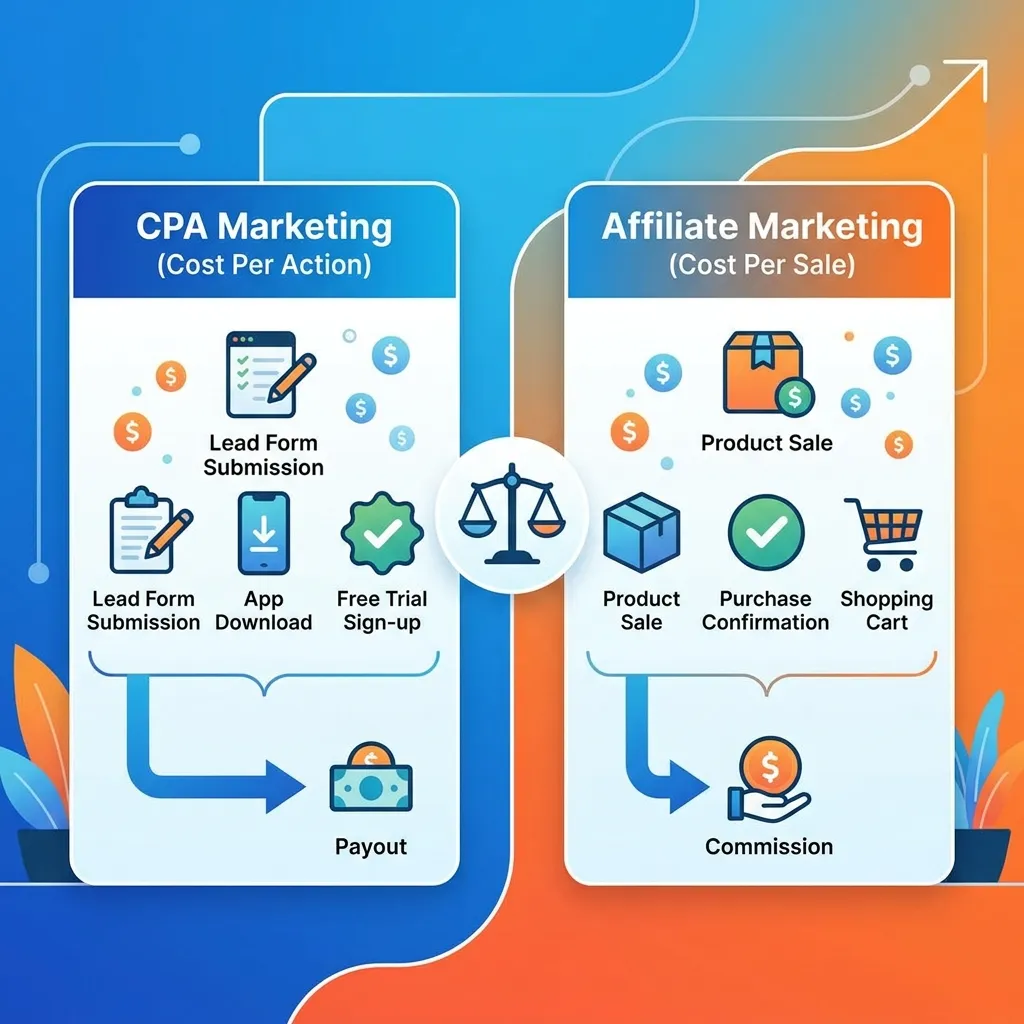
CPA Marketing vs Affiliate Marketing compares a fast, action-based model with a trust-driven sales model, helping marketers choose the right traffic, content, and monetization strategy.
Understanding the Core Idea
CPA Marketing vs Affiliate Marketing is often discussed like a battle between two online income models, but the smarter view is to treat it as a strategic comparison. One model rewards simple actions such as form submissions, app installs, or email signups. The other rewards completed sales, subscriptions, or other revenue events. When you understand CPA Marketing vs Affiliate Marketing, you stop guessing and start matching the right business model to your audience, budget, and traffic source.
At a psychological level, CPA Marketing vs Affiliate Marketing matters because people respond differently to low-friction offers versus high-commitment offers. A visitor may hesitate to buy a product on the first click, yet they may willingly submit an email or install an app. That difference changes how you write, where you place links, and how you measure success.
What CPA Marketing Really Means
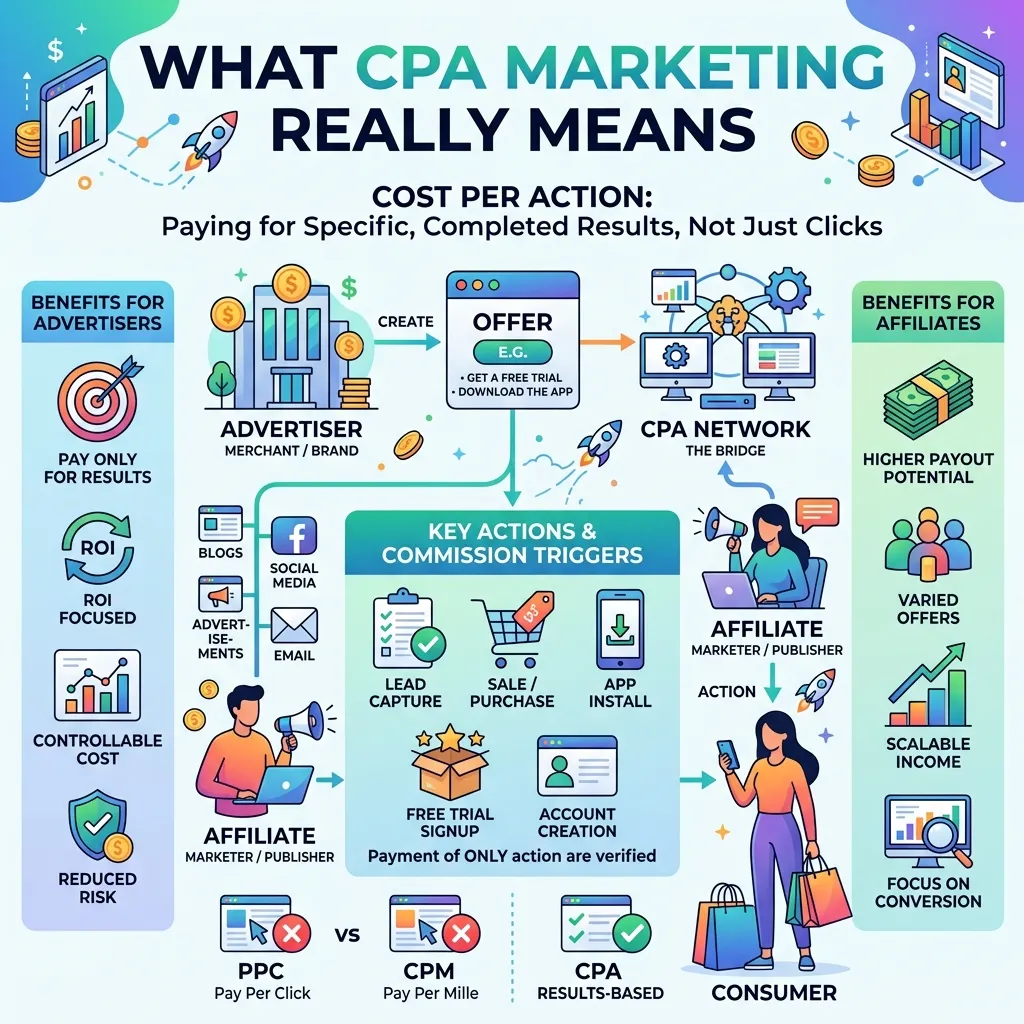
In practical terms, CPA stands for cost per action. You earn when the user completes a predefined action that the advertiser values. That action may be a lead, an app install, a trial signup, or a specific form completion. This is why CPA Marketing vs Affiliate Marketing often becomes a question of speed versus depth. CPA campaigns can be faster to launch, easier to test, and more forgiving for beginners who have limited experience.
For anyone searching for CPA Marketing for Beginners, the main advantage is simplicity. Instead of pushing a hard sale, you guide the user toward one small step. That makes the offer feel lighter and reduces resistance. The tradeoff is that you must choose your traffic carefully, because many networks have strict rules and low-quality traffic can get rejected quickly.
What Affiliate Marketing Really Means
Affiliate marketing pays a commission when a referred visitor completes a purchase or another qualifying revenue event. Compared with CPA, the buyer journey is usually longer, and the content often needs more trust-building. In CPA Marketing vs Affiliate Marketing, affiliate marketing is the side that rewards persuasion, education, and intent matching. You are not only trying to get a click; you are trying to help the reader feel confident enough to buy.
This is where Affiliate Marketing Keyword Research becomes essential. If you understand what people are searching for, you can build pages that answer their exact questions and guide them toward a product that fits. Affiliate marketing usually gives you more control over the customer journey, but it can also require more patience because conversions depend on trust, product fit, and timing.
CPA Marketing vs Affiliate Marketing: The Real Difference
CPA Marketing vs Affiliate Marketing is not just about commission structure. It is about friction, traffic quality, content style, and the level of trust required to convert. CPA campaigns often work well with direct-response messaging because the action is small. Affiliate campaigns often need deeper explanations, comparisons, and proof because the purchase commitment is larger.
One useful way to think about CPA Marketing vs Affiliate Marketing is this: CPA is often optimized for immediate micro-conversions, while affiliate marketing is often optimized for high-intent sales. That means the same traffic can behave very differently depending on the offer. Someone who clicks an app install offer may not be ready to buy software, but they may still be useful traffic for a CPA funnel.
This distinction is why CPA Marketing vs Affiliate Marketing should not be chosen by hype. It should be chosen by your strengths. If you are good at writing quick landing pages, testing ads, and getting fast feedback, CPA can feel natural. If you are better at long-form content, review articles, and trust-building, affiliate marketing may fit better.
Traffic Sources and User Intent
Traffic source matters more than many beginners realize. In CPA Marketing vs Affiliate Marketing, the best offer is useless if the traffic source does not match the offer intent. Search traffic, social traffic, push traffic, email traffic, and paid ads all behave differently. A user who searches for a solution is already demonstrating intent, while a user who scrolls casually through social feeds may need more persuasion.
That is why Content Marketing can be especially effective for affiliate campaigns. You can create helpful pages that educate first and sell later. For CPA, direct response traffic often performs better because the offer requires less commitment. However, even CPA needs relevance. If the offer and the traffic are mismatched, clicks will not translate into actions.
In CPA Marketing vs Affiliate Marketing, the strongest campaigns usually start with a clear buyer persona and a single promise. When the offer solves a problem the user already feels, conversion rates improve naturally. When the offer feels random, users hesitate, bounce, or ignore the page.
CPA Marketing for Beginners: A Simple Starting Path
For CPA Marketing for Beginners, the easiest path is to start with one niche, one traffic source, and one offer type. This reduces confusion and lets you learn the mechanics of tracking, testing, and optimizing without trying to do everything at once. Beginners often fail because they switch offers too quickly. A better approach is to collect enough data before making a judgment.
In CPA Marketing vs Affiliate Marketing, beginners should think about funnels, not just offers. A simple funnel may include a traffic source, a landing page, a pre-sell page, and the final offer page. Each layer has a job. The traffic source attracts attention, the landing page filters interest, and the offer page converts action. When one step underperforms, the entire funnel suffers.
It also helps to track the emotional experience of the visitor. Does the page feel clear, quick, and useful? Or does it feel pushy and confusing? CPA audiences often respond best when the next step looks easy. Reducing friction is a form of persuasion.
Affiliate Marketing Keyword Research and Search Intent

A major advantage of affiliate marketing is that content can compound over time. Affiliate Marketing Keyword Research helps you find topics that already have buying intent, problem-solving intent, or comparison intent. That means you are not guessing what the audience wants. You are using the search results as evidence of demand.
When building around CPA Marketing vs Affiliate Marketing, search intent should guide every piece of content. Informational queries need education. Commercial investigation queries need comparisons, pros and cons, and product positioning. Transactional queries may need strong offers, bonuses, or detailed reviews. The better your keyword-to-intent match, the easier the conversion path becomes.
This is also where Low Competition Affiliate Keywords become valuable. Smaller, more specific phrases often have less competition and a clearer user need. Instead of chasing broad terms, you can target highly relevant topics that are easier to rank and more likely to convert. That strategy is especially useful for newer sites.
Content Marketing as the Bridge Between Traffic and Trust
Affiliate Marketing Keyword Research is not just about publishing articles. It is about building a structured path from curiosity to confidence. A good content strategy answers questions in the order people naturally ask them. First they want to understand the problem. Then they want to compare options. Finally they want reassurance before taking action.
In CPA Marketing vs Affiliate Marketing, content marketing can support both models, but it often plays a bigger role in affiliate campaigns because the sale requires more trust. Educational articles, comparison guides, tutorials, and case studies all help reduce uncertainty. The more a reader feels understood, the more likely they are to follow your recommendation.
For CPA, content still matters because it can improve click quality and pre-frame the offer. Even a simple landing page can benefit from clarity, social proof, and problem-focused messaging. The difference is that CPA usually needs less depth than a full affiliate content ecosystem.
Building a Practical Strategy
A smart approach to CPA Marketing vs Affiliate Marketing is to separate the models by business goal. If your goal is quick testing and faster feedback, CPA may be the better launchpad. If your goal is long-term search traffic, evergreen content, and brand trust, affiliate marketing may be the better foundation. Many marketers eventually combine both models, using CPA for testing and affiliate content for scale.
When planning a campaign, ask three questions. What problem is the audience trying to solve? What action feels easiest for them right now? What type of content or page removes the most doubt? These questions keep your campaign aligned with user psychology instead of vanity metrics.
A simple decision framework can help.
| Factor | CPA Marketing | Affiliate Marketing |
|---|---|---|
| Conversion type | Small action | Purchase or revenue event |
| Trust required | Lower | Higher |
| Best content style | Direct response | Education and comparison |
| Speed to test | Fast | Slower |
| Long-term compounding | Moderate | Strong |
| Best for beginners | Often yes | Yes, with patience |
This table shows why CPA Marketing vs Affiliate Marketing is not about one model being universally better. It is about fit. The right choice depends on your skills, content strengths, and traffic source.
How to Think About Competition and Opportunity
One of the easiest ways to waste time in CPA Marketing vs Affiliate Marketing is to chase crowded topics without a plan. High competition is not always bad, but it does raise the bar. New sites often perform better when they focus on narrower angles, especially when they can provide clearer answers than larger competitors.
That is why Low Competition Affiliate Keywords are so valuable in affiliate content planning. Specific terms often reveal under-served questions, product variations, or beginner concerns that large sites overlook. These topics may not look glamorous, but they can bring steady, targeted traffic.
For CPA, opportunity often exists in offer testing, geo targeting, and audience matching. A simple offer can outperform a fancy one when the message is aligned with the user’s moment of need. Proven CPA Marketing often wins not because it is magical, but because it fits the traffic source well.
Mistakes Beginners Should Avoid
Beginners in CPA Marketing vs Affiliate Marketing usually make the same mistakes. They choose an offer before understanding the audience. They create content without a search intent plan. They copy other marketers without adapting the message. They also expect immediate results, which is one of the fastest ways to quit too early.
Another common mistake is treating every click as equal. In reality, a click from a highly motivated user is far more valuable than a random click from someone who was only mildly curious. That is why CPA Marketing vs Affiliate Marketing requires careful thinking about quality, not just volume.
The best way to avoid mistakes is to simplify. Start with one niche, one funnel, and one clear outcome. Measure what matters, improve one element at a time, and use the data to make the next decision. This discipline is what turns experimentation into a real business.
Why Psychology Matters More Than Tactics
CPA Marketing vs Affiliate Marketing works best when you understand how people decide. Users rarely convert because of logic alone. They convert when clarity, trust, timing, and perceived ease line up. That is true in CPA and it is true in affiliate marketing. The structure may differ, but the human mind still looks for safety and relevance.
In CPA, the user often says yes because the action feels small and low risk. In affiliate marketing, the user says yes because the recommendation feels credible and useful. That means your copy should reflect the user’s internal question at each stage: Is this easy? Is this safe? Is this worth my time? Does this solve my problem?
Once you think this way, CPA Marketing vs Affiliate Marketing becomes less about platform tricks and more about communication. Good marketers do not just push traffic. They reduce uncertainty.
A Better Long-Term Approach

If you are building a business rather than chasing a short burst of income, CPA Marketing vs Affiliate Marketing should guide your systems. Build pages that can rank, email sequences that can nurture, and campaigns that can be measured. The strongest operators are usually the ones who can test quickly, learn from data, and then create assets that compound.
That is where Content Marketing becomes powerful. When content is helpful, targeted, and aligned with buyer intent, it can keep generating leads and sales long after the initial work is done. CPA can be excellent for speed and testing, while affiliate marketing can be excellent for authority and scalability. The best path often uses both.
If you combine direct-response thinking with content-driven trust building, you create a more stable business. You are no longer dependent on one traffic source or one offer. You are building a system that can adapt.
Final Comparison
At the end of the day, CPA Marketing vs Affiliate Marketing is not a contest with one permanent winner. CPA is often better for fast action, simpler offers, and lower-friction conversions. Affiliate marketing is often better for educational content, higher trust, and long-term compounding. The right model depends on your niche, your traffic source, and your ability to match user intent.
For many marketers, the best strategy is not choosing one forever. It is learning both models, understanding where each one excels, and using them in the right place. That mindset creates flexibility, reduces risk, and improves the odds of building a sustainable online income stream.
Practical Decision Notes
- For launches, CPA Marketing vs Affiliate Marketing depends on the action you want visitors to take.
- For quick validation, CPA Marketing vs Affiliate Marketing often favors lower-commitment offers.
- In trust-based niches, CPA Marketing vs Affiliate Marketing works best with education, comparisons, and proof.
- For cold audiences, CPA Marketing vs Affiliate Marketing benefits from simple offers and clear messaging.
- For warm audiences, CPA Marketing vs Affiliate Marketing performs well with reviews and case studies.
- With paid traffic, CPA Marketing vs Affiliate Marketing relies on strong ad-to-offer alignment.
- For search traffic, CPA Marketing vs Affiliate Marketing succeeds with intent-focused content.
- Beginners should test CPA Marketing vs Affiliate Marketing one model at a time.
- To scale, CPA Marketing vs Affiliate Marketing requires consistent tracking and optimization.
- For long-term growth, CPA Marketing vs Affiliate Marketing should focus on evergreen content.
- Direct-response campaigns need CPA Marketing vs Affiliate Marketing with clear, urgent messaging.
- Authority websites benefit from CPA Marketing vs Affiliate Marketing through valuable, credible content.
Conclusion
CPA Marketing vs Affiliate Marketing is best understood as a choice between speed and depth, micro-conversions and purchase conversions, testing and trust. CPA can help you move quickly, while affiliate marketing can help you build long-term authority. The real winner is the model that fits your audience, your content strengths, and your traffic source. If you focus on intent, clarity, and usefulness, both paths can produce real results. The smartest marketers test, refine, and scale the system that creates the best user experience and the strongest conversion rate. That mindset keeps campaigns sustainable, practical, and easier for beginners to follow.
FAQ
1. What is the main difference between CPA and affiliate marketing?
CPA Marketing vs Affiliate Marketing differs mainly in the type of action that gets rewarded. CPA pays for small actions like leads or signups, while affiliate marketing pays for sales or other revenue events.
2. Is CPA marketing easier for beginners?
CPA Marketing vs Affiliate Marketing often feels easier at first because the required action is smaller. Still, beginners need good tracking, proper traffic, and careful offer selection.
3. Which is better for content websites?
CPA Marketing vs Affiliate Marketing often favors affiliate marketing for content sites because articles can educate readers, build trust, and lead naturally to a purchase decision.
4. Can I use both CPA and affiliate marketing together?
CPA Marketing vs Affiliate Marketing absolutely can be combined. Many marketers use CPA for faster testing and affiliate marketing for longer-term income and deeper content funnels.
5. How do keywords help affiliate success?
CPA Marketing vs Affiliate Marketing becomes much stronger when you use search intent properly. That is why Affiliate Marketing Keyword Research and Low Competition Affiliate Keywords help attract the right visitors at the right stage.
6. What kind of content works best for CPA?
CPA Marketing vs Affiliate Marketing usually works best with direct, clear, and low-friction pages. Simple pre-sell content, landing pages, and tightly matched offers tend to perform well.
7. Does CPA require a lot of traffic?
CPA Marketing vs Affiliate Marketing can benefit from volume, but quality matters more than raw traffic. Relevant traffic that matches the offer usually performs better than broad traffic.
8. Is affiliate marketing more sustainable?
CPA Marketing vs Affiliate Marketing often becomes more sustainable through evergreen content, search traffic, and trust. It can compound over time if the content stays relevant.
9. What is the biggest mistake in CPA marketing?
CPA Marketing vs Affiliate Marketing usually fails when marketers choose the wrong traffic source or ignore compliance. Low-quality traffic and poor targeting can kill performance quickly.
10. How should a beginner start?
CPA Marketing vs Affiliate Marketing is easiest to learn by choosing one niche, one offer type, and one traffic source. Then test, track results, and improve one part of the funnel at a time.


Leave a Reply