


To master CPA (Cost Per Action) campaign optimization, marketers must implement data-driven strategies that track core metrics like conversion rates and ROI. By leveraging advanced analytics, conducting rigorous A/B testing, and using predictive models, businesses can drastically reduce acquisition costs and improve overall campaign profitability.
Cost Per Action (CPA) marketing is a highly effective advertising model where advertisers pay for a specific action—such as a sale, click, or form submission. Because you only pay for tangible results, CPA marketing is highly favored by budget-conscious businesses. However, achieving sustainable success requires more than just setting up an account and hoping for the best.
Data is the lifeblood of modern advertising. Without a clear understanding of your numbers, you are essentially flying blind. Implementing robust data-driven strategies allows you to pinpoint exactly what works, eliminate wasteful spending, and scale profitable campaigns. This comprehensive guide explores how to leverage data at every stage of your campaign, ensuring your marketing efforts are both effective and highly efficient.
What are the foundational metrics for data-driven CPA strategies?
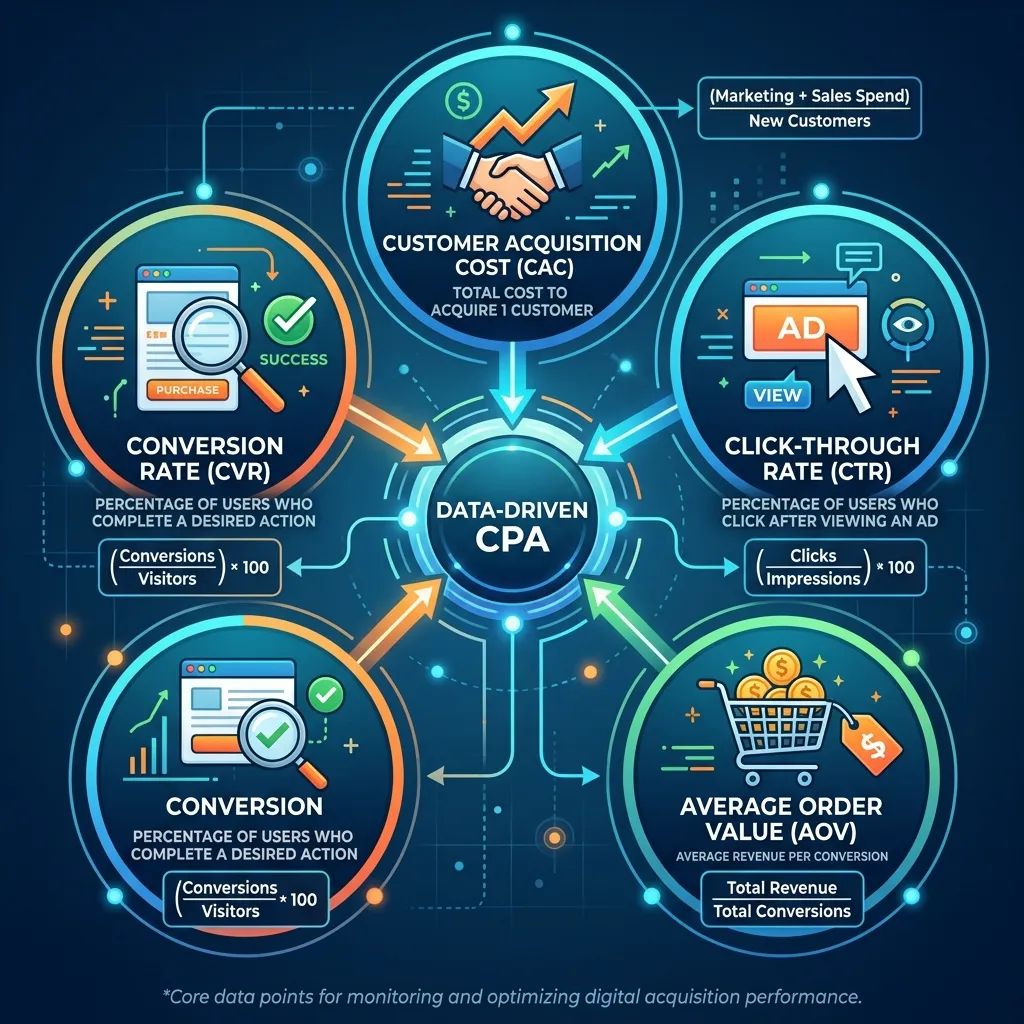
To optimize any campaign, you must first understand the metrics that indicate success or failure. Tracking the right data points provides a baseline for all future optimization efforts.
Key CPA metrics to track
There are several core metrics every CPA marketer must monitor:
- CPA (Cost Per Action): The total cost of a campaign divided by the number of successful actions.
- CTR (Click-Through Rate): The percentage of people who click on your ad after seeing it. A low CTR indicates your ad creative or targeting needs adjustment.
- Conversion Rate: The percentage of visitors who complete the desired action after clicking your ad.
- ROI (Return on Investment): The ultimate measure of profitability, calculating the revenue generated compared to the ad spend.
Tracking and analyzing metrics effectively
Successful marketers use a combination of pixel tracking, server-to-server (postback) tracking, and UTM parameters to monitor user behavior. Setting up postback tracking ensures accurate attribution, even when browsers block third-party cookies.
Setting baselines and benchmarks
Before making changes, establish a baseline for your current performance. Look at industry benchmarks for your specific niche to understand what a “good” CPA or CTR looks like. If the industry average conversion rate for finance offers is 5%, and you are hitting 2%, you immediately know where to focus your optimization efforts.
How can marketers leverage analytics for deeper insights?

Raw data is useless without context. Analytics tools help translate raw numbers into actionable insights.
Using Google Analytics and specialized tools
Google Analytics remains a staple for tracking website traffic and user behavior. For CPA campaigns, pairing Google Analytics with specialized affiliate tracking software (like Voluum, RedTrack, or BeMob) provides granular insights into which specific ad placements, devices, and times of day drive the most conversions.
Identifying trends and patterns
Analyze your data over specific timeframes to spot trends. You might discover that your ads convert 30% higher on mobile devices during evening hours, or that specific geographical regions yield a significantly lower CPA.
Segmenting data for targeted optimization
Segmentation involves breaking your audience down by demographics, device, operating system, or behavior. By segmenting your data, you can create hyper-targeted campaigns. Choose specific segmentation if identifying highly profitable micro-audiences matters more than broad brand awareness.
What are some Proven CPA Marketing Strategies powered by data?
Once you understand your data, you can implement Proven CPA Marketing Strategies to drive better results.
A/B testing ad creatives and landing pages
Data-driven marketers never guess; they test. Run A/B tests on your headlines, ad copy, images, and call-to-action buttons. Test one variable at a time until you achieve statistical significance, ensuring that your winning variant is truly driving better results.
Optimizing targeting based on behavioral data
Use historical data to refine your audience targeting. If the data shows that users aged 25-34 convert at twice the rate of other groups, reallocate your budget to focus heavily on that demographic.
Bid management strategies
Review your historical performance data to adjust your bidding strategy. Decrease bids on low-converting placements to save budget, and increase bids on high-converting placements to maximize volume.
Ad copy optimization
Analyze which emotional triggers or value propositions yield the highest CTR. If ads emphasizing “saving money” outperform those emphasizing “saving time,” use the data to guide your future copywriting efforts.
How do you choose CPA Networks to Maximize reach and revenue?
Partnering with the right network is critical for scaling your efforts. Evaluating CPA Networks to Maximize your revenue requires a strategic, analytical approach.
Choosing the right CPA network
Look for networks that specialize in your niche. Analyze the network’s payment terms, offer variety, and tracking reliability. Networks with exclusive offers often provide higher payouts, which directly improves your ROI.
Leveraging network data for competitive analysis
Many networks provide EPC (Earnings Per Click) and conversion rate data for their top offers. Use this network-level data to gauge the overall market demand and select offers with a proven track record of converting.
Building relationships with network managers
Your affiliate manager has access to vast amounts of platform data. Build a strong relationship with them. They can tell you which traffic sources are currently performing best for specific offers, saving you thousands of dollars in initial testing.
How is CPA Marketing Demystified through data?
Many beginners find CPA marketing complex and risky. However, CPA Marketing Demystified simply comes down to overcoming common challenges using hard data.
Addressing ad fraud with data
Ad fraud can quickly drain your budget. Monitor your analytics for suspicious patterns, such as clicks with zero time-on-page, unusually high CTRs with zero conversions, or traffic originating from single IP blocks. Data-driven detection tools help block fraudulent traffic sources automatically.
Improving conversion rates through funnel analysis
Map out your entire user journey, from the initial ad click to the final conversion page. Use heatmaps and session recordings to see where users drop off. If 80% of users abandon your landing page at the form-fill stage, your data indicates the form is too long or complex.
Scaling campaigns effectively
Once a campaign is profitable, use performance data to scale. Gradually increase your daily budget on winning ad sets, or expand your targeting to similar lookalike audiences based on the profiles of your converting users.
What advanced data-driven strategies lead to CPA mastery?
To outpace the competition, leading marketers deploy advanced technologies and methodologies.
Predictive analytics for future performance
Predictive analytics uses historical data to forecast future outcomes. By understanding past conversion trends, you can predict seasonal spikes in demand and adjust your inventory, budget, and bidding strategies proactively.
Utilizing AI and machine learning
AI algorithms process vast amounts of data much faster than humans. Utilize AI-powered bidding tools provided by ad platforms (like Google’s Target CPA) to automatically adjust bids in real-time based on the likelihood of a conversion.
Integrating first-party data
First-party data—information you collect directly from your audience—is incredibly valuable. Use email lists, purchase history, and site behavior to create hyper-personalized remarketing campaigns.
How do real-world businesses succeed with data-driven CPA?
Examining case studies provides concrete proof of the power of data optimization.
Examples of successful campaigns
Consider a software company that utilized granular demographic data to optimize its CPA campaign. By identifying that IT managers in specific coastal cities had a 40% higher conversion rate, they localized their ad copy and reallocated their budget. This data-driven pivot reduced their overall CPA by 35% while doubling lead volume.
Lessons learned from data adjustments
Conversely, ignoring data often leads to failure. A common mistake is scaling a campaign too quickly without analyzing the data. An advertiser might double their budget on a weekend, only to realize later that their target audience is strictly active during weekday business hours. Analyzing day-parting data prevents these costly errors.
Your Roadmap to CPA Campaign Optimization

Achieving mastery in CPA marketing is not a one-time event; it is an ongoing process of refinement. The most successful marketers rely heavily on Data-Driven Strategies to guide every decision, from initial offer selection to advanced audience segmentation.
By continuously analyzing metrics, rigorously testing creative elements, and leveraging predictive analytics, you can transform an average campaign into a highly profitable revenue stream. Commit to understanding your data, build strong relationships with your networks, and remain agile enough to adapt to the numbers.
Frequently Asked Questions (FAQ)
1. What are the most important metrics to track in a CPA campaign?
When implementing Data-Driven Strategies, the most important metrics include Cost Per Action (CPA), Click-Through Rate (CTR), Conversion Rate (CR), Earnings Per Click (EPC), and Return on Investment (ROI). These metrics help marketers understand which campaigns generate profitable actions and which areas need optimization. Strong Data-Driven Strategies rely on accurate performance measurement rather than assumptions.
2. How often should I analyze my CPA campaign data?
Successful Data-Driven Strategies require regular monitoring. During the launch phase, checking campaign performance daily helps identify issues quickly and prevents unnecessary spending. Once a campaign becomes stable, weekly or bi-weekly analysis is usually sufficient. Consistent reviews ensure that your Data-Driven Strategies remain aligned with changing market conditions and user behavior.
3. Can data analytics really help reduce CPA?
Absolutely. One of the biggest advantages of Data-Driven Strategies is the ability to identify underperforming traffic sources, ads, audiences, and placements. By eliminating waste and reallocating budget toward high-converting segments, marketers can significantly reduce their Cost Per Action while improving overall profitability.
4. What are some common data analysis tools for CPA marketers?
Many marketers use tools such as Google Analytics, Voluum, RedTrack, ClickMagick, and native advertising dashboards. These platforms provide valuable insights that support Data-Driven Strategies by tracking user behavior, conversions, traffic quality, and campaign performance across multiple channels.
5. How do I choose the best CPA network using data?
A smart approach involves comparing network metrics such as Earnings Per Click (EPC), conversion rates, offer approval rates, and payment reliability. Effective Data-Driven Strategies focus on measurable performance indicators instead of relying solely on network popularity or recommendations.
6. What is the role of A/B testing in Data-Driven Strategies?
A/B testing is one of the foundations of Data-Driven Strategies. It allows marketers to compare different ad creatives, headlines, landing pages, and calls-to-action to determine which version generates the best results. Instead of guessing, decisions are based on real user behavior and statistical evidence.
7. How can I use data to prevent ad fraud in CPA campaigns?
Fraud prevention is an important part of modern Data-Driven Strategies. Marketers should monitor suspicious patterns such as unusually high CTRs with no conversions, repeated IP addresses, bot traffic, and abnormal user behavior. Specialized fraud-detection tools can help identify and block low-quality traffic before it wastes advertising budget.
8. What is predictive analytics in the context of CPA marketing?
Predictive analytics uses historical campaign data, machine learning, and statistical models to forecast future outcomes. Advanced Data-Driven Strategies leverage predictive analytics to identify likely converters, anticipate market trends, optimize bids, and allocate budgets more efficiently before performance issues occur.
9. How can I optimize landing pages based on data?
Landing page optimization is a key component of Data-Driven Strategies. Tools such as heatmaps, scroll maps, session recordings, and conversion tracking reveal how visitors interact with a page. These insights help marketers improve page design, simplify forms, strengthen calls-to-action, and increase conversion rates.
10. Is it necessary to use AI for CPA campaign optimization?
AI is not mandatory, but it can significantly enhance Data-Driven Strategies. AI-powered systems can process large amounts of campaign data, automate bid adjustments, identify audience patterns, and optimize targeting in real time. For marketers managing large-scale campaigns, AI often provides a competitive advantage.
11. What is the difference between first-party and third-party data in CPA marketing?
First-party data comes directly from your own audience, such as website visitors, email subscribers, and customer interactions. Third-party data is collected by external providers. Strong Data-Driven Strategies prioritize first-party data because it is generally more accurate, reliable, and valuable for personalization and retargeting efforts.
12. How can I stay updated on new Data-Driven Strategies trends?
To keep up with evolving Data-Driven Strategies, follow industry blogs, attend affiliate marketing conferences, join professional communities, and participate in performance marketing forums. Regular learning helps marketers adapt to new technologies, algorithm updates, privacy regulations, and emerging optimization techniques that influence campaign success.


Comments (1)
Postback URL in CPA Marketing Explained: Setup & Guide Metasays:
August 20, 2026 at 8:20 am[…] properly firing postback URL is the foundation for any data-driven optimization approach, which our guide to data-driven CPA campaign strategies explores […]