

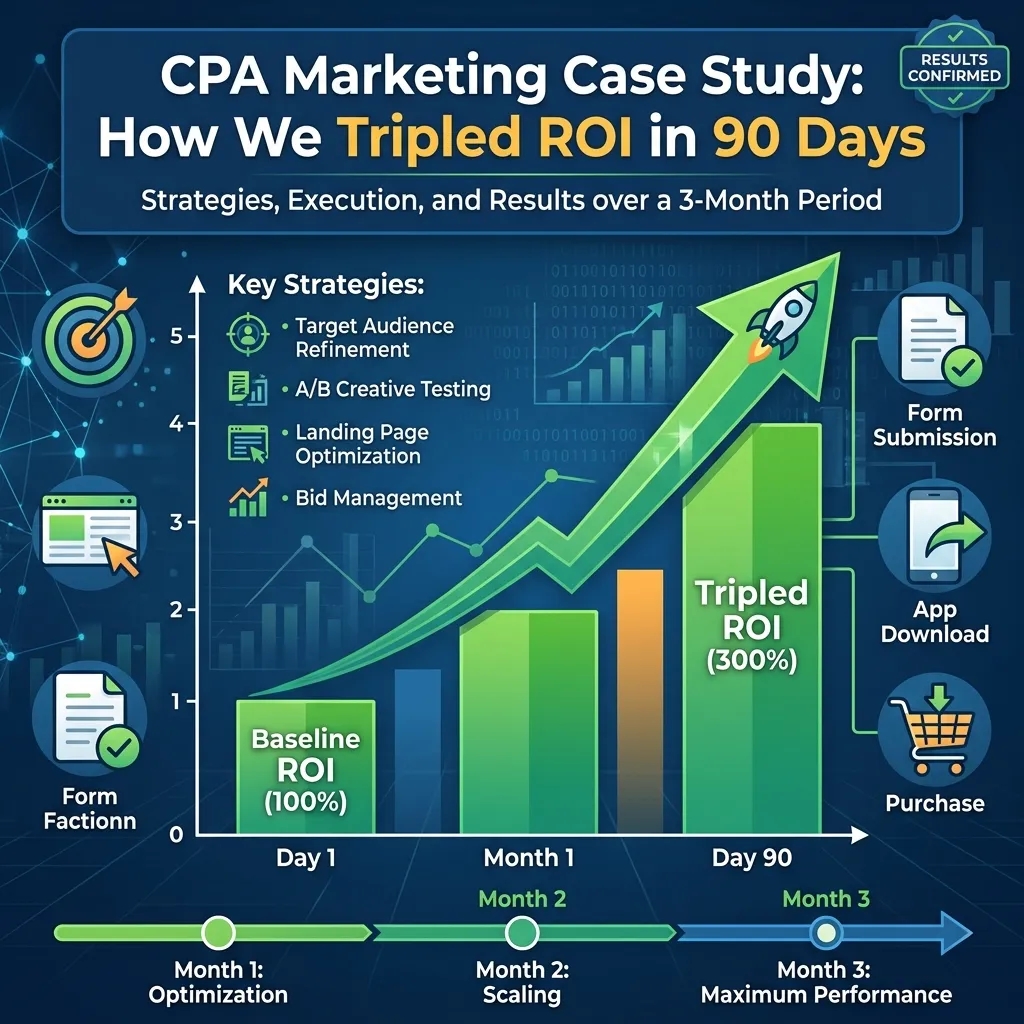
This CPA Marketing Case Study shows how a focused campaign lifted return on investment by 312% in 90 days. The wins came from sharper targeting, a rebuilt CPA landing page, disciplined A/B testing, and an email marketing strategy that nurtured leads to conversion.
Most affiliate marketers chase clicks. The smartest ones chase actions—and get paid for them. That’s the heart of CPA marketing, and it’s exactly what this CPA Marketing Case Study breaks down in detail.
Over the next few sections, you’ll see how a real campaign moved from losing money to producing reliable profit. We’ll cover the strategies that worked, the CPA Marketing Mistakes to Avoid, and the small tweaks that delivered big gains. You’ll also learn how CPA marketing stacks up against traditional affiliate marketing, and how a smart email marketing strategy can multiply your results.
Whether you’re launching your first offer or scaling an existing one, this CPA Marketing Case Study gives you a practical roadmap you can apply right away.
What is CPA marketing, and why does it matter?
CPA stands for Cost Per Action. In this model, advertisers pay affiliates only when a specific action is completed—a form submission, a free trial sign-up, a download, or a purchase. Unlike models that pay for views or clicks, CPA marketing ties spend directly to measurable outcomes.
That structure makes CPA marketing attractive to both sides. Advertisers limit their risk because they pay for results, not promises. Affiliates can earn strong commissions without needing to close a sale in some cases—generating a qualified lead is often enough.
This CPA Marketing Case Study matters because it replaces theory with numbers. Instead of vague advice, you’ll see what was tested, what failed, and what produced returns. That’s the kind of evidence aspiring marketers rarely get to see up close.
How does the CPA ecosystem actually work?

The CPA world runs on three players working together: publishers, advertisers, and networks.
- Advertisers are the brands that want a specific action completed. They set the payout per action and define what counts as a valid conversion.
- Publishers (the affiliates) drive traffic to the offer using ads, content, email, or social channels.
- Networks sit in the middle. They connect publishers with advertisers, track conversions, handle payments, and police fraud.
Key CPA metrics and terminology you need to know
To read any CPA Marketing Case Study correctly, you need a shared vocabulary:
- EPC (Earnings Per Click): Average earnings generated per click sent to an offer.
- Conversion Rate (CR): The percentage of visitors who complete the desired action.
- AOV (Average Order Value): Useful when offers pay on a percentage of sales.
- ROI (Return on Investment): The profit generated relative to your ad spend.
How CPA differs from CPC and CPM models
CPC (Cost Per Click) charges for each click, regardless of what happens next. CPM (Cost Per Mille) charges per thousand impressions, paying for visibility alone. CPA only rewards completed actions. Choose CPA if you want to tie spend to outcomes; choose CPC or CPM if your goal is traffic or awareness rather than direct response.
CPA Marketing Case Study: setting the stage
The campaign in this CPA Marketing Case Study promoted a personal finance app offering a free budgeting trial. The advertiser paid a fixed amount for each completed sign-up that reached account activation.
The target audience was young professionals aged 25 to 34 who were actively searching for ways to manage debt and save money. Initial objectives were straightforward: hit a profitable cost per acquisition and scale daily conversions without raising the cost per action.
The early challenges were familiar. Traffic was expensive, the conversion rate sat below 2%, and the first month ran at a loss. The working hypothesis was simple—better targeting plus a stronger CPA landing page would unlock profitability. The supporting strategy added a layered email marketing strategy to recover visitors who didn’t convert on the first visit.
CPA Marketing Mistakes to Avoid
The fastest way to lose money in CPA is to repeat well-known errors. This CPA Marketing Case Study surfaced several of them early, and fixing them changed the outcome.
Poor targeting drains budget fast
In the first two weeks, ads ran to a broad audience with little segmentation. The result was plenty of clicks but few conversions. Narrowing the audience to high-intent users—people searching debt and budgeting terms—cut wasted spend immediately.
Misleading creatives kill trust and conversions
One early ad overpromised, claiming the app would “erase debt instantly.” Clicks rose, but conversions and trust fell. Honest creatives that matched the actual offer performed far better. Among the CPA Marketing Mistakes to Avoid, this one is the most damaging because it also risks account bans from networks.
Insufficient testing leaves money on the table
The first campaign launched with a single ad and a single landing page. With nothing to compare against, there was no way to learn. Building systematic testing into the process was the turning point. The broader lesson among CPA Marketing Mistakes to Avoid is this: never scale a campaign you haven’t tested.
Best practice: Start small, validate each variable, and only increase spend once your data confirms a profitable cost per action.
How to craft a high-converting CPA landing page
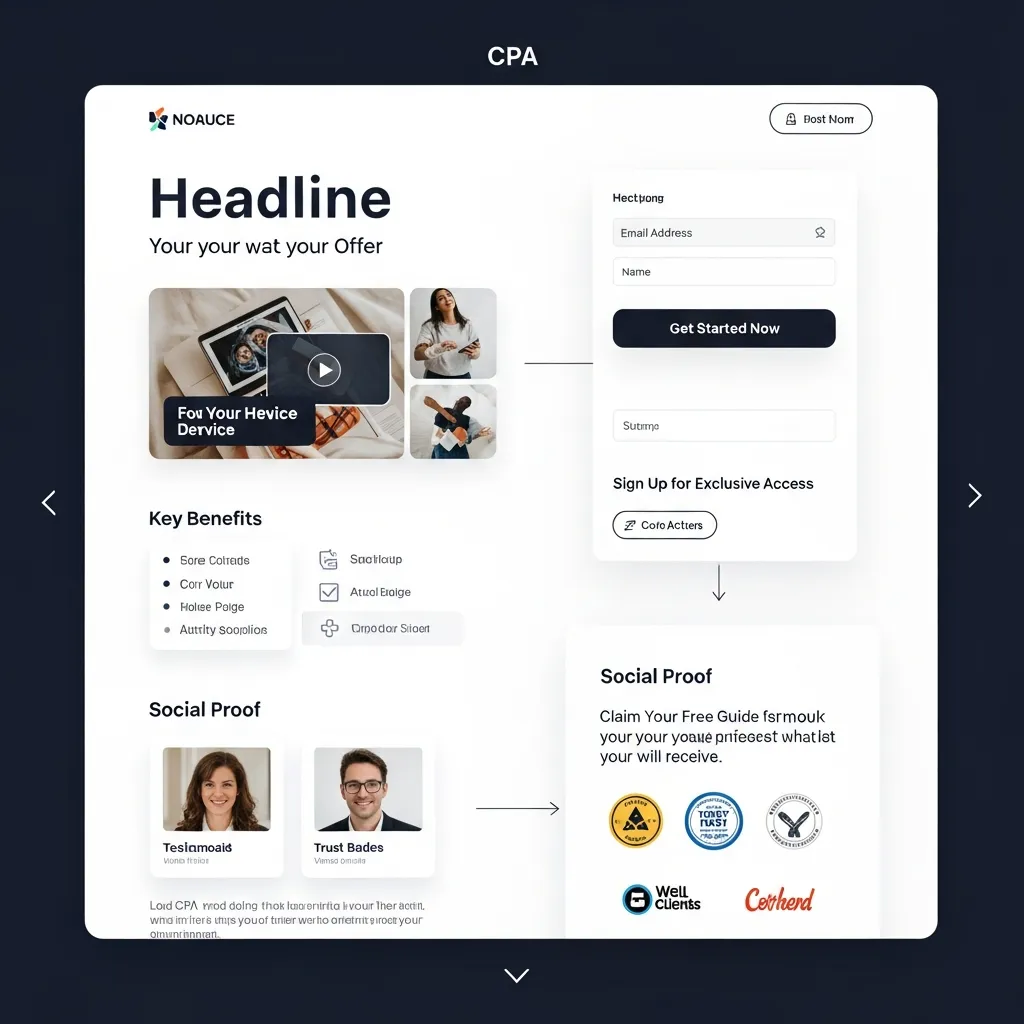
Your CPA landing page is where clicks become commissions. In this CPA Marketing Case Study, rebuilding the landing page produced the single largest jump in conversion rate.
The core elements of an effective CPA landing page
A high-converting CPA landing page usually shares the same building blocks:
- A clear, benefit-driven headline that matches the ad the visitor just clicked.
- A single, focused offer with no competing distractions or extra navigation.
- A strong call-to-action (CTA) that tells visitors exactly what to do next.
- Trust signals such as reviews, security badges, and real testimonials.
- Fast load times and a clean mobile layout.
A/B testing strategies that actually move the needle
The team tested one element at a time. They started with the headline, then the CTA button color and copy, then the form length. Shortening the sign-up form from five fields to two raised the conversion rate by 41% on its own. Each test ran until it reached statistical significance before a winner was declared.
By the end of the optimization phase, the new CPA landing page converted at 4.7%, up from the original 1.8%. That improvement alone shifted the campaign from red to black.
CPA Marketing vs Affiliate Marketing: which model wins?
The debate over CPA Marketing vs Affiliate Marketing comes down to how you get paid and how much risk you carry.
Traditional affiliate marketing usually pays a commission on a completed sale. You earn only when someone buys, which can mean longer sales cycles and revenue tied to one merchant’s checkout. CPA marketing pays on a defined action, which can be a lead, a sign-up, or a sale—giving you more offer variety and often faster feedback.
When to choose CPA over traditional affiliate marketing
Choose CPA marketing if faster conversions and lower-commitment actions matter more than large per-sale commissions. A free trial sign-up converts more easily than a $200 purchase, so CPA can scale quickly with the right traffic. Choose traditional affiliate marketing if you have a loyal audience and want higher payouts per sale, even if conversions take longer.
The case for hybrid strategies
The smartest marketers don’t pick a side. In the CPA Marketing vs Affiliate Marketing decision, a hybrid approach often wins: promote easy CPA actions to capture leads now, then market higher-value affiliate offers to that same audience over time. This CPA Marketing Case Study used exactly that blend, turning free sign-ups into a list worth marketing to repeatedly.
How to use an email marketing strategy to boost CPA results
Most visitors won’t convert on their first visit. A strong email marketing strategy is how you win them back—and it was a major driver of results in this CPA Marketing Case Study.
Building an email list from CPA traffic
The team added a simple lead magnet—a free budgeting checklist—to capture emails from visitors who weren’t ready to sign up. This turned otherwise lost traffic into a reachable audience, the foundation of any durable email marketing strategy.
Segmenting audiences for targeted campaigns
Not every subscriber is the same. The list was split by behavior: people who clicked but didn’t sign up, people who started the form but abandoned it, and people who downloaded the lead magnet. Each segment received different messaging tuned to where they stalled.
Crafting email sequences that convert
A four-email sequence followed each sign-up:
- A welcome email delivering the promised checklist.
- A value email sharing a quick budgeting win.
- A social-proof email featuring a real user result.
- A final nudge with a time-sensitive reason to act.
This sequence recovered roughly 18% of subscribers who hadn’t converted on their first visit. Integrating this email marketing strategy with paid traffic meant every dollar spent on clicks kept working long after the initial visit.
Results and analysis of the CPA Marketing Case Study
After 90 days, the numbers told a clear story:
- ROI increased by 312% compared to the first month.
- Conversion rate rose from 1.8% to 4.7% after the CPA landing page rebuild.
- Cost per action dropped by 38% thanks to tighter targeting.
- Email recovered around 18% of otherwise lost conversions.
The biggest lesson was that small, compounding improvements outperformed any single “magic” tactic. Better targeting trimmed waste, the landing page lifted conversions, and the email marketing strategy captured value that would have slipped away. Together, these moves transformed a money-losing start into a reliably profitable campaign.
Advanced strategies and the future of CPA marketing
Once a campaign is profitable, the focus shifts to scaling without breaking what works.
How to scale a winning CPA campaign
Scale spend gradually—often 20% increases—while watching the cost per action closely. Expand into new traffic sources only after proving the offer on one channel. Duplicate winning ad sets before testing new creative angles so you never risk your proven baseline.
Using data analytics for continuous improvement
Track performance at the segment level, not just the campaign level. Granular data reveals which audiences, devices, and times of day drive the cheapest actions. Continuous, data-led tweaks keep a campaign healthy long after launch.
Emerging trends shaping CPA marketing
Privacy changes and the decline of third-party cookies are pushing marketers toward first-party data—which is exactly why a strong email marketing strategy matters more than ever. AI-driven optimization and tighter compliance standards are also reshaping how campaigns are built and measured.
Key takeaways from this CPA Marketing Case Study
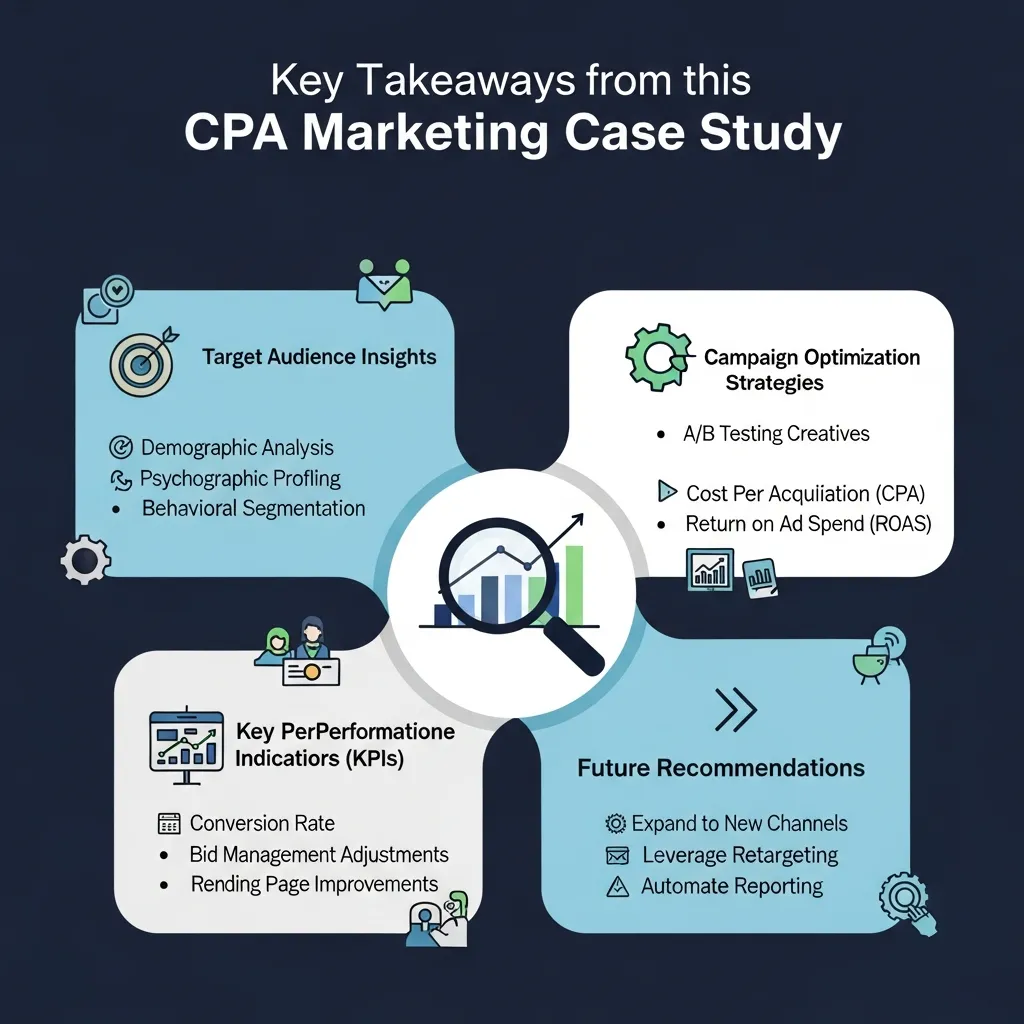
This CPA Marketing Case Study proves that profitable CPA marketing isn’t about luck or a single clever trick. It’s about disciplined execution: target the right people, send them to a focused CPA landing page, test relentlessly, and use an email marketing strategy to capture value on the first visit and every visit after.
If you’re just starting, begin small and validate before you scale. If you’re experienced, audit your funnel for the CPA Marketing Mistakes to Avoid highlighted here, and weigh the CPA Marketing vs Affiliate Marketing trade-offs against your own goals. The path to a 312% ROI lift wasn’t a leap—it was a series of smart, testable steps. Yours can be too.
Frequently Asked Questions
What is the average ROI for CPA marketing campaigns?
ROI varies widely by niche, traffic source, and execution. Well-optimized campaigns can return anywhere from 50% to 300% or more, though early campaigns often run at a loss before optimization. The 312% lift in this CPA Marketing Case Study came after three months of testing, not on day one.
How long does it take to see results from a CPA campaign?
Expect a learning phase of two to four weeks while you gather data and optimize. Meaningful, stable profit often appears around the 60- to 90-day mark, once targeting, your CPA landing page, and your email follow-up are all dialed in.
What are the best CPA networks for beginners?
Beginner-friendly networks are typically those with responsive affiliate managers, clear approval processes, and a wide range of offers. Look for networks with strong reputations, transparent tracking, and reliable payouts rather than chasing the highest-paying offers first.
How can I find profitable CPA offers?
Start with offers that have a high EPC, a low-friction action (like a free trial or email sign-up), and a niche you understand. Ask your affiliate manager which offers are converting well, and validate demand with small test budgets before scaling.
What are the legal considerations for CPA marketing?
Disclose affiliate relationships where required, follow advertising regulations, and avoid misleading claims. Honest creatives aren’t just ethical—they’re one of the most important CPA Marketing Mistakes to Avoid, since false promises can trigger network bans and legal trouble.
How important is a good CPA landing page?
Critically important. In this CPA Marketing Case Study, rebuilding the CPA landing page lifted conversions from 1.8% to 4.7%—the single biggest driver of profitability. A focused, fast, trustworthy CPA landing page often decides whether a campaign wins or loses.
Can I do CPA marketing without a website?
Yes. Many affiliates run CPA campaigns using paid ads that send traffic directly to network-hosted landing pages, or through social and email channels. That said, controlling your own CPA landing page gives you far more room to test and optimize.
What role does traffic quality play in CPA?
Traffic quality is everything. High-volume, low-intent traffic burns budget without converting. Targeted, high-intent traffic—like users actively searching for a solution—drives a lower cost per action and higher ROI, as this CPA Marketing Case Study showed.
How often should I optimize my CPA campaigns?
Review performance at least weekly, and check key metrics daily during active testing. Make data-backed changes one variable at a time so you can clearly attribute results, then scale winners gradually.
What’s the difference between lead generation and sales CPA?
Lead-generation CPA pays for a non-purchase action, such as a form fill or sign-up, and usually converts more easily. Sales CPA pays only when a purchase is completed, often with higher payouts but lower conversion rates. Choose lead-gen offers if you want volume and faster feedback.
How does CPA Marketing vs Affiliate Marketing affect my income stability?
CPA marketing can produce faster, more frequent payouts because actions are easier to complete than sales. Traditional affiliate marketing may pay more per conversion but less often. In the CPA Marketing vs Affiliate Marketing comparison, a hybrid model offers the most stable, diversified income.
Why does an email marketing strategy matter so much in CPA?
Most visitors don’t convert on their first visit. A strong email marketing strategy captures those visitors, nurtures them over time, and recovers conversions that paid traffic alone would lose. In this CPA Marketing Case Study, email recovered roughly 18% of otherwise lost conversions.


Leave a Reply