

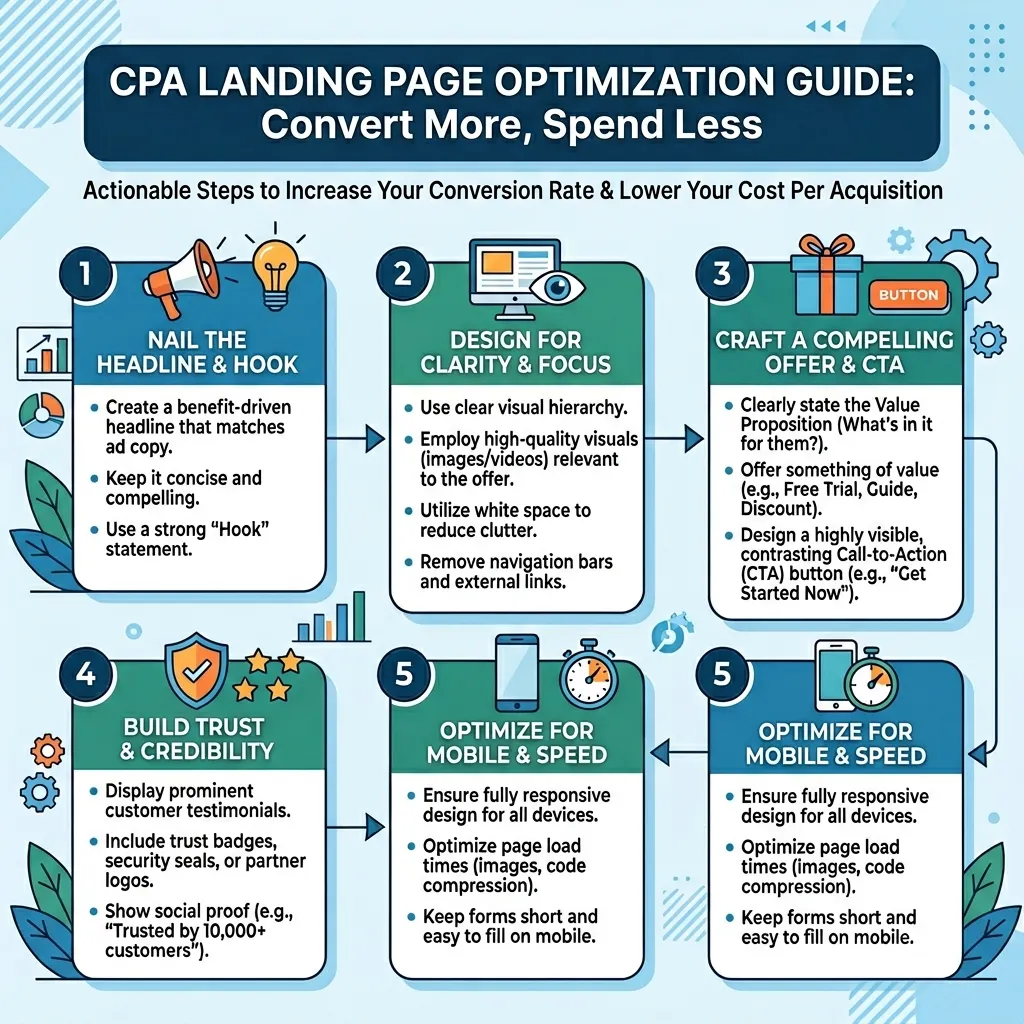
A CPA Landing Page Optimization Guide shows you how to design, write, and test landing pages that turn paid traffic into completed actions—like sign-ups, downloads, or purchases. The goal is to lower your cost per action (CPA) by improving conversion rates through clear headlines, strong CTAs, fast load times, trust signals, and continuous A/B testing.
Cost per action (CPA) marketing only works when your landing page does its job. You can run brilliant ads, target the perfect audience, and still lose money if visitors land on a page that confuses them or fails to earn their trust. The landing page is where clicks become conversions—or where your budget quietly disappears.
This CPA Landing Page Optimization Guide walks you through everything you need to build pages that convert. You’ll learn how to understand your audience, choose the right offers, craft persuasive copy, design for every device, and use data to keep improving. Whether you’re just starting out or refining an existing campaign, these strategies will help you get more actions for less money.
Let’s break down what makes a CPA landing page work, section by section.
What Is a CPA Landing Page?
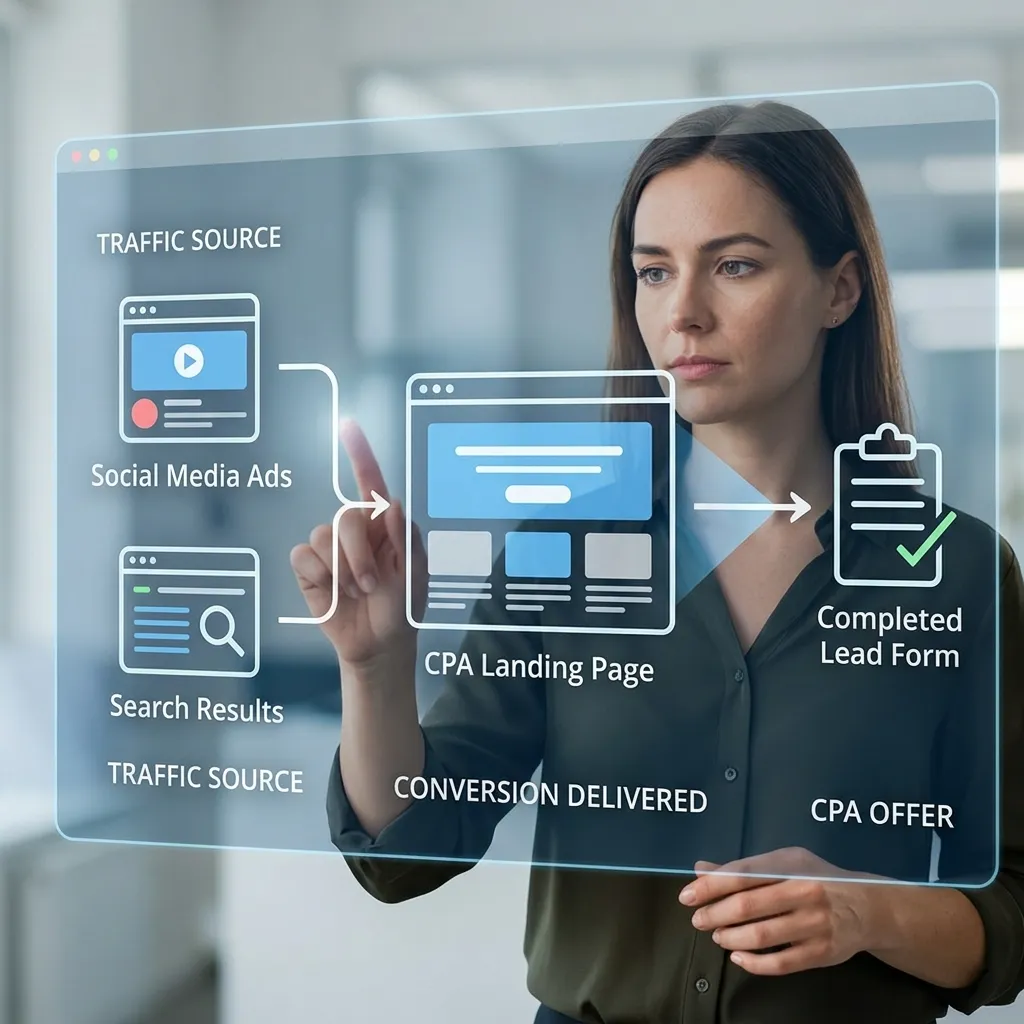
A CPA landing page is a standalone web page built to drive one specific action. In CPA marketing, you earn a commission each time a visitor completes that action—submitting an email, installing an app, filling out a form, or making a purchase. Unlike a homepage packed with links and options, a CPA landing page removes distractions and focuses the visitor on a single goal.
The page acts as the bridge between your ad and your offer. When someone clicks your ad, they expect a smooth, relevant experience. A well-built landing page delivers exactly that, guiding the visitor from interest to action without friction.
Why Is Landing Page Optimization Crucial for CPA?
Your CPA is calculated by dividing total ad spend by the number of actions completed. The math is simple: when more visitors convert, your cost per action drops. Even a small lift in conversion rate can dramatically improve your return on ad spend.
According to WordStream, the average landing page conversion rate across industries sits around 2.35%, while the top 25% of pages convert at 5.31% or higher. That gap represents real money. Optimization is what moves you from average to top-tier, helping you scale campaigns profitably instead of burning through your budget.
Section 1: Understanding Your Audience and Offer
Strong optimization starts long before you write a single headline. You need to know who you’re talking to and what you’re asking them to do.
Who Is Your Target Audience for a CPA Campaign?
Every high-converting page speaks directly to one person. Define your ideal visitor by their demographics, interests, pain points, and the traffic source that brought them in. Someone arriving from a Facebook ad has a different mindset than someone clicking a search result for a specific product.
Map out what your audience wants and what objections might stop them. The closer your page matches their expectations, the higher your conversion rate.
How Do You Analyze a CPA Offer?
Before promoting any offer, study its requirements. How much effort does the action demand? A free email sign-up converts far more easily than a credit card submission. Check the payout, the conversion flow, and any restrictions on traffic types. The best offers balance a fair payout with a low barrier to action.
How to Choose High-Converting CPA Offers
To choose high-converting CPA offers, look at three factors: relevance, simplicity, and earnings per click (EPC). Relevance means the offer matches your audience’s needs. Simplicity refers to how easy the action is to complete. EPC tells you how much affiliates typically earn per visitor—a higher EPC signals a proven, profitable offer.
Choose high-converting CPA offers that align with your traffic source. Mobile-heavy traffic pairs well with app installs, while desktop audiences often respond better to longer forms or purchases. Avoid offers with high payouts but complicated funnels, since complexity kills conversions.
Section 2: Key Elements of an Effective CPA Landing Page

These building blocks separate pages that convert from pages that flop.
Compelling Headlines and Subheadings
Your headline is the first thing visitors read, and often the only thing. Make it specific, benefit-driven, and matched to your ad’s promise. If your ad mentions a free trial, your headline should reinforce it instantly. Subheadings then expand on the value and guide readers deeper into the page.
Engaging Copywriting for Conversions
Good copy focuses on benefits, not just features. Tell visitors what they’ll gain and how their problem disappears. Keep sentences short, use the word “you” often, and address objections before they arise. Write the way your audience speaks.
Strong Call-to-Actions (CTAs)
Your CTA button should be impossible to miss and crystal clear about what happens next. Swap vague text like “Submit” for action-driven phrases like “Get My Free Guide” or “Start My Trial.” Use a contrasting color, place CTAs at multiple scroll points, and keep the surrounding space clean.
High-Quality Visuals (Images and Videos)
Images and videos build context and emotion fast. Show the product in use, the result your offer delivers, or a real person enjoying the benefit. A short explainer video can lift conversions significantly by answering questions text alone can’t. Keep file sizes optimized so visuals never slow your page.
Trust Signals: Testimonials, Reviews, and Badges
People convert when they feel safe. Add customer testimonials, star ratings, recognizable security badges, and any media mentions. Real names, photos, and specific results make testimonials far more believable than generic praise. Trust signals reduce hesitation right at the moment of decision.
Section 3: Design and User Experience (UX)
Even great copy fails on a clunky page. Design and UX determine whether visitors stay long enough to act.
Why Does Responsive Design Matter for CPA Pages?
More than half of web traffic comes from mobile devices, so your landing page must look and work flawlessly on every screen. Responsive design adjusts layout, font size, and buttons automatically. Test your page on phones, tablets, and desktops before driving any paid traffic to it.
How Can You Improve Landing Page Loading Speed?
Page speed directly affects conversions. Google research shows that as page load time goes from one to three seconds, the probability of a bounce increases by 32%. To speed up your page, compress images, minimize code, use a content delivery network (CDN), and enable browser caching. A fast page keeps both visitors and ad platforms happy.
Clear and Intuitive Navigation
On a CPA landing page, less navigation is better. Remove menu bars and external links that pull visitors away from your goal. Every element should guide the eye toward the CTA. A clean, focused layout keeps attention exactly where you want it.
A/B Testing Design Elements
Never assume you know what works best. Test one element at a time—button color, headline, image, or layout—and let data decide the winner. Small design changes can produce surprisingly large gains in conversion rate.
Section 4: Advanced Optimization Techniques
Once the fundamentals are solid, these tactics squeeze out extra performance.
Personalization and Dynamic Content
Personalization tailors your page to each visitor based on location, device, or traffic source. Dynamic content can swap headlines or images to match the keyword someone searched. When visitors see content that feels made for them, they convert more often.
Heatmaps and User Behavior Analysis
Heatmap tools like Hotjar or Crazy Egg show where visitors click, scroll, and drop off. This visual data reveals friction points you’d never spot in analytics alone. If users stop scrolling before reaching your CTA, you know exactly what to fix.
Implementing Exit-Intent Pop-ups
Exit-intent pop-ups trigger when a visitor moves to leave. A well-timed offer—a discount, bonus, or reminder—can recapture visitors who were about to bounce. Keep the message simple and the value clear.
Retargeting Strategies
Most visitors won’t convert on their first visit. Retargeting ads follow these users across the web, bringing them back to complete the action. Pair retargeting with a tailored landing page that acknowledges their earlier interest for stronger results.
Section 5: Tracking, Analytics, and Iteration
You can’t improve what you don’t measure. Data turns guesswork into a repeatable process.
Setting Up Conversion Tracking
Install tracking pixels and postback URLs to record every action accurately. Conversion tracking links each completed action back to its traffic source, ad, and keyword. Without it, you’re optimizing blind.
Analyzing Key Performance Indicators (KPIs)
Focus on metrics that reveal performance: conversion rate, cost per action, click-through rate, bounce rate, and earnings per click. Track these over time to spot trends and identify which pages and offers deserve more budget.
Continuous Optimization and A/B Testing
Optimization is never finished. Run A/B tests continuously, document results, and apply what you learn to future pages. Each test compounds your knowledge and lifts performance across campaigns.
CPA Marketing vs Affiliate Marketing
In the CPA Marketing vs Affiliate Marketing comparison, the difference comes down to scope. ECPA (effective cost per action) marketing focuses on optimizing the actual cost of each conversion, factoring in real performance data to measure profitability. Affiliate marketing is the broader model where you promote others’ products for a commission, often using CPA offers.
Put simply, the CPA Marketing vs Affiliate Marketing distinction is about measurement versus method. Affiliate marketing is the business model; CPA is a metric-driven approach to making that model profitable. Choose an CPA focus if you run high-volume campaigns where small cost differences add up fast.
Section 6: CPA Marketing Best Practices
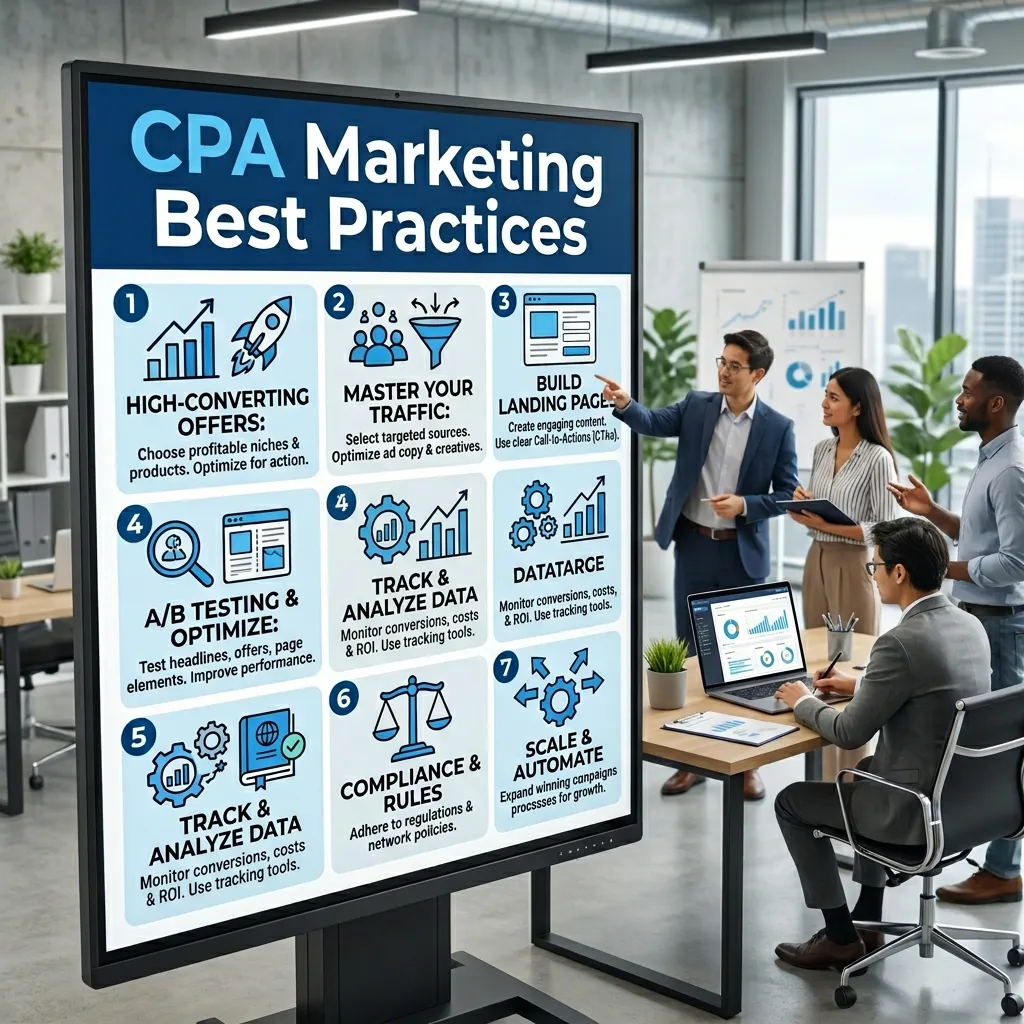
These habits keep your campaigns profitable and sustainable over the long term.
CPA Marketing for Beginners
CPA Marketing for Beginners works best when you start small and learn fast. Pick one traffic source, one simple offer, and one landing page. Master that combination before scaling. Track everything, reinvest profits carefully, and avoid spreading your budget too thin across many offers at once.
For anyone exploring CPA Marketing for Beginners, patience pays. Most successful marketers test dozens of offers before finding a winner, so treat early losses as tuition rather than failure.
Avoiding Common Landing Page Mistakes
The most common mistakes include slow load times, weak headlines, too many distractions, missing trust signals, and a mismatch between ad and page. Another frequent error is asking for too much information too soon. Every extra form field lowers your conversion rate.
Staying Compliant with Advertising Policies
Ad networks and CPA platforms enforce strict rules. Avoid misleading claims, fake scarcity, and prohibited content. Always include a privacy policy and clear terms. Compliance protects your accounts and your reputation, keeping your campaigns running without sudden shutdowns.
The Future of CPA Marketing
CPA marketing continues to evolve with automation, AI-driven optimization, and stricter privacy regulations. First-party data and transparent offers are becoming more valuable as third-party tracking fades. Marketers who adapt to these shifts will hold a lasting advantage.
Conclusion
A profitable campaign rests on one foundation: a landing page that converts. This CPA Landing Page Optimization Guide has covered the full journey—from understanding your audience and choosing the right offers to crafting persuasive copy, designing for speed, and refining everything through data.
Start with the fundamentals. Match your page to your audience, write a headline that delivers on your ad’s promise, and make your CTA impossible to ignore. Then layer in advanced tactics like personalization, heatmap analysis, and retargeting. Above all, keep testing. Small, consistent improvements are what turn an average page into a top performer.
Pick one page and one element to improve today. Measure the result, apply what you learn, and repeat. That steady loop of testing and refining is the real secret behind every high-converting CPA landing page.
Frequently Asked Questions
What is a CPA Landing Page Optimization Guide?
A CPA Landing Page Optimization Guide is a complete resource that explains how to optimize landing pages for cost-per-action campaigns. A quality CPA Landing Page Optimization Guide covers audience research, persuasive copywriting, page design, trust signals, and A/B testing to increase conversions and reduce acquisition costs.
Why is a landing page important in a CPA Landing Page Optimization Guide?
Every CPA Landing Page Optimization Guide emphasizes that the landing page is where visitors decide whether to complete your offer. A well-optimized landing page converts more traffic into actions, lowers your cost per action, and improves your overall CPA marketing performance.
How do I choose the best CPA offers using a CPA Landing Page Optimization Guide?
A CPA Landing Page Optimization Guide recommends choosing offers that match your audience, have simple conversion requirements, and provide strong earnings per click (EPC). Selecting offers that fit your traffic source increases conversion rates and campaign profitability.
What are the essential elements in a CPA Landing Page Optimization Guide?
A CPA Landing Page Optimization Guide recommends using a compelling headline, persuasive copy, a clear call-to-action, high-quality visuals, customer testimonials, trust badges, fast page speed, and a mobile-friendly design. These elements work together to maximize conversions.
How can I improve loading speed according to a CPA Landing Page Optimization Guide?
A CPA Landing Page Optimization Guide suggests compressing images, minimizing CSS and JavaScript files, using a CDN, enabling browser caching, and choosing reliable web hosting. Faster loading pages improve user experience and increase conversion rates.
Why is A/B testing important in a CPA Landing Page Optimization Guide?
Every CPA Landing Page Optimization Guide recommends A/B testing because it compares different versions of your landing page to identify which design, headline, or CTA generates more conversions. Continuous testing leads to steady performance improvements.
How does personalization improve a CPA Landing Page Optimization Guide?
A CPA Landing Page Optimization Guide explains that personalization improves conversions by displaying content based on user location, device, interests, or search intent. Personalized landing pages create a better user experience and increase engagement.
Which metrics should I monitor in a CPA Landing Page Optimization Guide?
A CPA Landing Page Optimization Guide recommends tracking conversion rate, click-through rate (CTR), bounce rate, cost per action (CPA), earnings per click (EPC), and return on ad spend (ROAS). These metrics help identify optimization opportunities and improve campaign performance.
What mistakes should I avoid in a CPA Landing Page Optimization Guide?
A CPA Landing Page Optimization Guide advises avoiding slow-loading pages, weak headlines, too many distractions, missing trust signals, inconsistent messaging between ads and landing pages, and long forms. Eliminating these mistakes significantly improves conversion rates.
How does CPA Marketing compare in a CPA Landing Page Optimization Guide?
A CPA Landing Page Optimization Guide explains that CPA Marketing focuses on measuring the actual cost of each conversion, while affiliate marketing is the broader business model for earning commissions. Understanding both concepts helps marketers optimize campaigns more effectively.
What are the best tips in a CPA Landing Page Optimization Guide for beginners?
A CPA Landing Page Optimization Guide recommends that beginners start with one traffic source, one landing page, and one CPA offer. Focus on testing, tracking data, improving conversion rates, and scaling only after achieving consistent profitability.
How can I keep my landing page compliant with a CPA Landing Page Optimization Guide?
A CPA Landing Page Optimization Guide recommends following advertising platform policies, avoiding misleading claims, including privacy policies and terms of service, and being transparent about offers. Compliance protects your advertising accounts and builds long-term trust with visitors.


Leave a Reply